


Quick answer
MOM WSH Ergonomics & Industrial Workbench Compliance in : The Complete Guide (2026) is important because workplace ergonomics is no longer a voluntary best practice for Singapore employers — it is a regulatory obligation under the Workplace Safety and Health Act (WSH Act) and its subsidiary regulations. The practical goal is to improve safety, productivity, and buying confidence before selecting equipment or requesting a quotation.
Practical next steps
- Confirm the load, workspace, workflow, and safety requirements.
- Compare the product fit against daily operating conditions, not just catalogue specifications.
- Speak with YK Toh for sizing, compatibility, and quotation guidance.
Workplace ergonomics is no longer a voluntary best practice for Singapore employers — it is a regulatory obligation under the Workplace Safety and Health Act (WSH Act) and its subsidiary regulations. The Ministry of Manpower’s WSH (Risk Management) Regulations require every employer to conduct documented risk assessments for all workstations, identify ergonomic hazards, and implement reasonably practicable controls.
For employers in Singapore who operate industrial workbenches — in electronics manufacturing, logistics, automotive service, food processing, or any sector where workstations are a core operational element — non-compliance is not a theoretical risk. MOM conducts targeted inspections of high-risk industries, ergonomic-related musculoskeletal disorder (MSD) claims generate investigation triggers, and facilities that cannot demonstrate documented risk assessments and implemented controls face enforcement action.
The Legal Framework: WSH Act and Subsidiary Regulations

WSH Act (Cap. 354A): The primary workplace safety and health legislation in Singapore. Section 12 imposes a general duty on every employer and self-employed person to take reasonably practicable steps to ensure the safety and health of workers.
WSH (Risk Management) Regulations 2008: Require a systematic approach to hazard identification, risk assessment, and control implementation. For workstations, this means a documented risk assessment covering physical, ergonomic, chemical, and biological hazards.
WSH (Incident Reporting) Regulations: Work-related injuries — including musculoskeletal disorders — that result in more than 4 days of incapacitation or medical treatment beyond first aid must be reported to MOM. An ergonomic deficiency at a workstation that contributes to an MSD is a documented liability.
MOM Enforcement Priorities
MOM’s inspection framework targets ergonomic risk factors specifically. Key enforcement focus areas relevant to workbench operations:
- Prolonged standing without ergonomic intervention (fixed-height benches in multi-shift operations)
- Repetitive manual handling tasks at workstations
- Fixed workstations shared by operators of significantly different physical dimensions
- Workstations where the work surface height is not matched to the task or the operator
Facilities with high MSD incident rates (measured by the Total Recordable Incident Rate, TRIR) receive priority inspection attention. A proactive ergonomics programme — including proper workbench specification — is the most effective risk management response.
MOM’s Ergonomics Guidelines: What They Require
MOM’s guidelines on preventing musculoskeletal disorders in the workplace (derived from international standards including ISO 6385, EN ISO 9241, and the European Framework Directive 90/269/EEC) establish the ergonomic parameters that apply to workstation design in Singapore.
Key Ergonomic Parameters for Workbenches
Work surface height: For precision hand tasks (electronics assembly, fine mechanical work): work surface at elbow height minus 50–100mm for standing, minus 150–200mm for seated. For general assembly: work surface at elbow height. For heavy tasks where downward force is applied: work surface 100–150mm below elbow height.
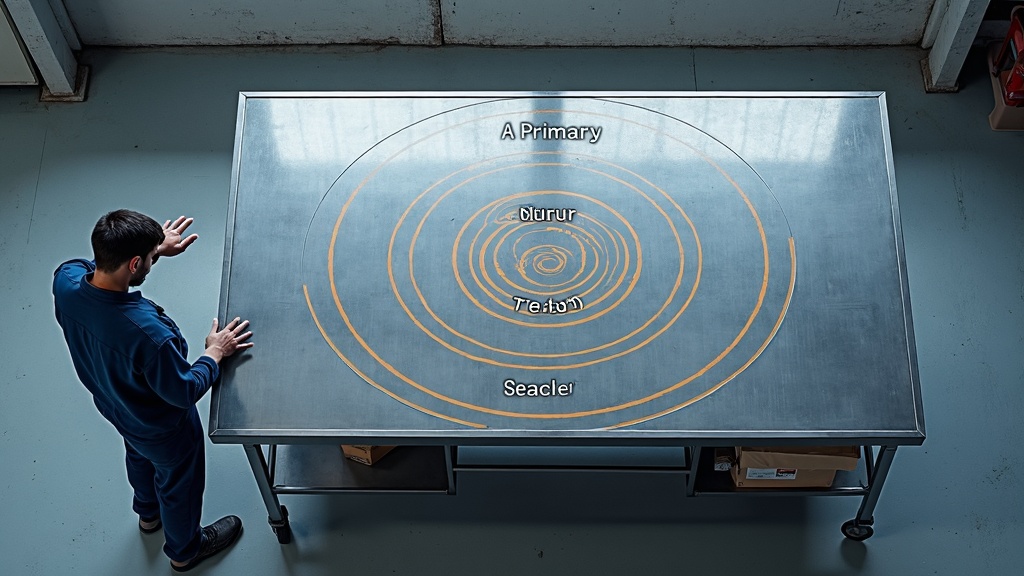
Ergonomic Reach Zones
| Zone | Distance from Body | Items to Store |
|---|---|---|
| Primary reach | 0–400mm | Items used every cycle; primary tools |
| Secondary reach | 400–700mm | Items used several times per shift |
| Tertiary reach | 700–1,000mm | Items used once per shift or less |
| Beyond reach | > 1,000mm | Requires leaving the workstation |
Standing Duration Thresholds
- Less than 2 hours per shift: standard anti-fatigue mat is adequate intervention
- 2–4 hours per shift: anti-fatigue mat + scheduled seated breaks required
- More than 4 hours per shift: height-adjustable workbench (sit-stand) is the required engineering control
The Workbench as an Engineering Control Under WSH
Once a hazard has been identified through the risk assessment, the employer must implement controls. The hierarchy of controls places engineering controls above administrative controls:
- Elimination: Remove the hazard entirely
- Substitution: Replace with something less hazardous
- Engineering controls: Isolate people from the hazard — this is where workbench specification sits
- Administrative controls: Change how people work (job rotation, rest breaks)
- PPE: Protect the individual (least effective, last resort)
Workbench specification is a primary engineering control for ergonomic risk. The choice of a height-adjustable bench over a fixed-height bench, and the choice of a bench at the correct height for the task, are engineering control decisions that directly address ergonomic risk under MOM’s framework.
Documenting Ergonomic Risk Assessments for Workbenches
A compliant ergonomic risk assessment for a workstation should include:
- Workstation Description: Location, function, tasks performed, duration per shift, operator demographics
- Hazard Identification: Prolonged standing, repetitive motions, awkward postures, manual handling weights and frequency, reach distances
- Risk Assessment: Risk rating using the MOM-recommended 5×5 risk matrix (likelihood × consequence)
- Control Measures: Engineering controls (workbench height, adjustability), administrative controls (job rotation, rest breaks), basis for selection, responsible parties
- Review and Monitoring: Schedule for periodic review (minimum annually), monitoring indicators (MSD incident rate, workstation audit results)
Height-Adjustable Workbenches as MOM-Compliant Engineering Controls
The MOM’s ergonomics guidelines specifically identify sit-stand workstations as the appropriate engineering control for prolonged standing in multi-task or multi-user environments.
When a Height-Adjustable Bench is Legally Required
A height-adjustable workbench is not optional when: an operator stands for more than 4 hours per shift; the workstation is shared by operators of different heights without a fixed designated operator; the task requires different work surface heights; or a risk assessment has identified an ergonomic deficiency related to fixed-height work surface.
A fixed-height bench specified in any of these scenarios creates a documented non-compliance position for the employer.
Minimum Specifications for MOM-Compliant Height Adjustment
| Parameter | Minimum for MOM Compliance | Recommended |
|---|---|---|
| Height range | 650–1,100mm | 600–1,280mm |
| Adjustment mechanism | Manual crank acceptable | Electric preferred for frequent use |
| Memory presets | Not required | 4 presets for multi-operator use |
| Load capacity | Maximum anticipated load | Maximum load × 1.25 |
| Anti-collision | Not required | Required if benches within 1.5m |
Seating and Standing Support for Workbench Operations
Standing Workstations

For standing workbenches, the primary ergonomic interventions beyond height adjustment are: minimum 15mm thickness industrial rubber anti-fatigue mat at the standing position; under-bench footrests allowing alternating foot placement; and scheduled breaks with postural variation at 30–60 minute intervals.
Seated Workstations

For seated workstations (test, inspection, assembly of small components): an ESD-safe caster chair that is height-adjustable with grounded seat and back, anti-static casters, and allows the operator’s feet to rest flat on the floor with thighs parallel to the ground. Where seated work is performed for more than 2 continuous hours, the operator must have access to a standing-height option or sit-stand bench.
MSD Reporting and the Workstation Connection
Under the WSH (Incident Reporting) Regulations, the following ergonomic-related conditions are reportable if they arise from work: musculoskeletal disorders of the neck, shoulder, upper back, lower back, arm, wrist, hand, knee, or lower leg; tendinitis, tenosynovitis, carpal tunnel syndrome; herniated discs and other spinal conditions where work-related ergonomic factors are present.
When MOM investigates a reported MSD case, the investigator will examine: whether a risk assessment was conducted; whether controls were identified and implemented; and whether the controls were adequate. A compliant ergonomics programme with documented risk assessments and implemented controls — including appropriate workbench specification — is the employer’s primary protection.
Common MOM WSH Compliance Mistakes Related to Workbenches
Mistake 1: No documented risk assessment for the workstation. The absence of reported incidents does not mean the workstation is compliant. The obligation to assess and control risk exists regardless of incident history.
Mistake 2: Engineering controls not implemented despite identified risk. A risk assessment that identifies prolonged standing as a high-risk hazard but addresses it only with administrative controls (rest breaks) without implementing a height-adjustable workstation does not meet the “reasonably practicable” standard.
Mistake 3: Purchasing fixed-height benches for multi-user workstations. A fixed-height bench without considering operator height variation is inherently inadequate for multi-user environments. Only a height-adjustable bench can address the ergonomic needs of operators across the height range.
Mistake 4: No review when tasks or operators change. Risk assessments become outdated when work tasks, products, or operator cohorts change. A workstation that now handles different components needs a risk assessment review before the new task begins.
Engaging MOM and Third-Party Ergonomics Consultants
MOM’s Workplace Safety and Health (WSH) Council provides ergonomic guidelines, training resources, and advisory services. The WSH Council’s Ergonomics Guidelines for Preventing Musculoskeletal Disorders is the primary reference document.
Third-party ergonomics consultants can conduct formal ergonomic risk assessments for complex or high-risk workstation environments. A consultant’s report provides defensible documentation in the event of a MOM investigation.
Frequently Asked Questions
Q: What does MOM require for a workstation where operators stand for 6 hours per shift?
A: Under MOM’s ergonomics guidelines, prolonged standing for more than 4 hours per shift requires a sit-stand workstation as the primary engineering control. A fixed-height bench in this scenario is non-compliant with the “reasonably practicable” requirement under the WSH Act.
Q: Do I need a formal ergonomic risk assessment for every workstation?
A: The WSH (Risk Management) Regulations require risk assessments for all workstations. The level of detail scales with the risk: a simple assessment for low-risk office workstations, a detailed assessment for high-risk industrial workstations. For industrial workbenches in Singapore, a documented assessment covering work surface height, standing duration, reach zones, and manual handling is the minimum.
Q: What height-adjustable bench specifications meet MOM ergonomic guidelines?
A: MOM’s guidelines specify a work surface at elbow height for the task and operator. For multi-user or prolonged-standing workstations, the bench must be height-adjustable across a range that accommodates the 5th percentile female (approximately 650mm minimum) to the 95th percentile male (approximately 1,100mm maximum) Singapore operator population.
Q: How often should ergonomic risk assessments for workstations be reviewed?
A: Minimum annually, and whenever there is a significant change in the task, product, equipment, or operator cohort. A workstation that changes from handling 5kg to 20kg components needs a risk assessment review before the new task begins.
Next Steps
If your facility has not conducted ergonomic risk assessments for industrial workstations, or if existing assessments have not resulted in implemented engineering controls, our team can support workstation specification reviews that address your MOM WSH compliance obligations.
Related Articles:
Ergonomics & Industrial Workbenches | Heavy Duty Workbenches | Workbench Buying Guide
Y K Toh Marketing (S) Pte Ltd
Tel: (65) 6542 3232 | enquiry@yktoh.com | yktoh.com


