


Quick answer
Electric Height-Adjustable Workbenches in : The Complete Guide (2026) is important because prolonged standing is one of the most consistently underestimated ergonomic risks in Singapore operations. The practical goal is to improve safety, productivity, and buying confidence before selecting equipment or requesting a quotation.
Practical next steps
- Confirm the load, workspace, workflow, and safety requirements.
- Compare the product fit against daily operating conditions, not just catalogue specifications.
- Speak with YK Toh for sizing, compatibility, and quotation guidance.
Prolonged standing is one of the most consistently underestimated ergonomic risks in Singapore’s workplaces. The WSH (Risk Management) Regulations under Singapore’s Workplace Safety and Health Act require employers to assess and mitigate ergonomic risks — and standing for extended periods without variation is a documented risk factor for musculoskeletal disorders, lower back pain, and cardiovascular strain.
Key Benefits of Electric Height Adjustable Workbenches
- Instant height adjustment at the touch of a button improves ergonomics for all operators
- Enables sit-stand working which reduces musculoskeletal disorders associated with prolonged sitting
- Programmable memory settings allow different operators to recall their preferred working heights instantly
- Smooth electric drive is quieter and more reliable than manual crank alternatives
- Integrated collision detection prevents damage to equipment and injury to operators
- Compatible with anti-fatigue mats for added comfort during standing work periods
An electric height-adjustable workbench — a sit-stand workstation — allows the work surface to move between sitting and standing height at the push of a button. In the context of Singapore’s MOM WSH regulations and the growing awareness of sedentary work risks, it is a compliance tool and a talent retention asset.
1. Why Electric Height Adjustment Matters in Singapore
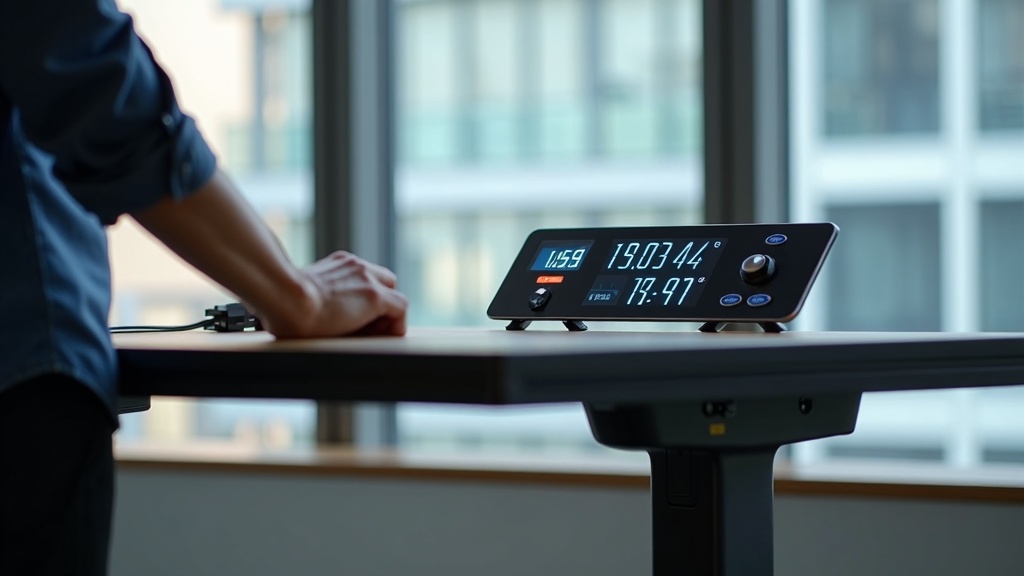
The health impacts of prolonged standing: Lower back pain (lumbar spine under continuous load when standing without movement); musculoskeletal disorders in legs, hips, and lower back; cardiovascular strain (reduced blood flow back to the heart, increased venous pressure in legs).
Singapore’s MOM guidelines reference ISO 6385 (Ergonomic principles in the design of work systems), which specifies that workstations should accommodate both seated and standing postures.
2. How Electric Height-Adjustable Workbenches Work
Motor Configuration
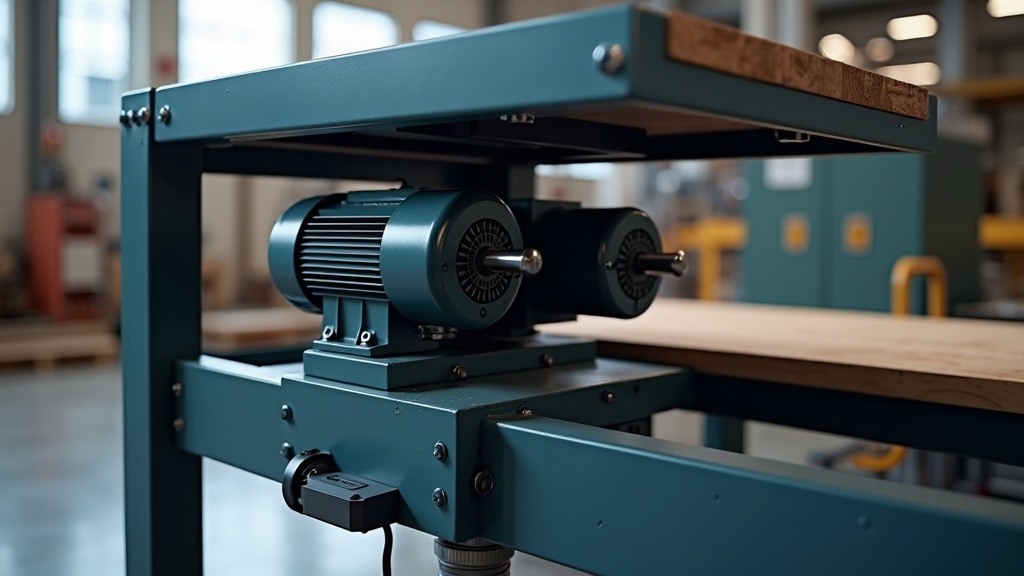
| Configuration | Description | Best For |
|---|---|---|
| Single motor | One motor drives both columns via connecting shaft | Budget systems; light-duty applications |
| Dual motor | Each column has own motor; synchronised movement | Standard and heavy-duty; recommended for Singapore industrial environments |
| Triple motor | Three columns for very long or very heavy surfaces | Extra-large work surfaces; heavy industrial applications |
Columns and Height Range
Height range: Typical minimum 650–750mm (seated) to maximum 1,100–1,300mm (standing). Verify this covers your tallest operator in standing position and your seated task requirements.
Critical specification — derating: Some manufacturers rate lift capacity at mid-stroke and reduce it at full extension. A bench rated at 100kg per column at 700mm may derate to 60kg per column at 1,200mm. Always verify the lift capacity at maximum height.
Control Panel Features
Memory presets: 2–4 programmable height positions. Essential in multi-operator environments — each operator retrieves their preferred height with one button press. Anti-collision sensors: Detects obstacles during adjustment and stops the motor. Required in shared workspaces where two benches may pass each other. Digital display: Shows current height for verifying and reproducing exact positions.
3. Singapore-Specific Considerations
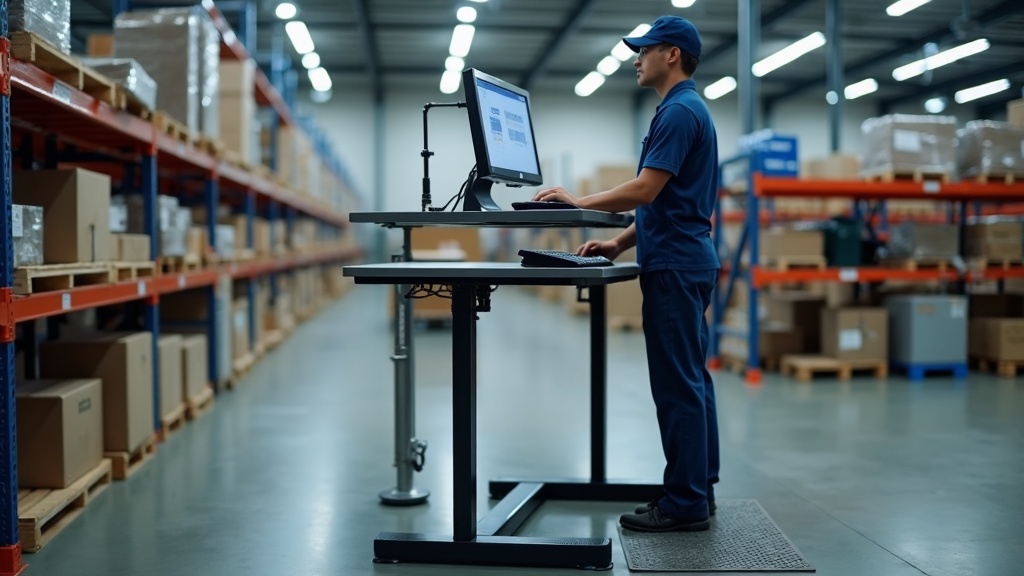
For logistics and packing stations: Heavy load capacity (minimum 100–150kg per column), electric height adjustment for fast shift-change reconfiguration, anti-collision sensors for shared aisle environments, robust enclosed cable carrier chain.
For electronics and precision assembly: Dual motor with minimum 50kg per column, memory presets for different operators, enclosed drag chains for cable protection, ESD-safe work surface option.
For laboratory and cleanroom: Stainless steel or powder-coated frame, verify motor and column design does not generate particles beyond cleanroom class limit, anti-collision sensors, height range covering seated (650mm) to standing (1,100–1,200mm).
4. Common Mistakes When Specifying Electric Height-Adjustable Workbenches
Mistake 1: Specifying single motor for a heavy application. A single motor driving a two-column bench is a false economy for any application with more than 30kg on the work surface — uneven lift and eventual frame misalignment result.
Mistake 2: Not verifying lift capacity at maximum height. The most common deceptive specification is quoting lift capacity at mid-stroke rather than at full extension. Always request the lift capacity chart — lift vs height — before specifying.
Mistake 3: Ignoring cable carrier chain quality. The cable carrier chain is the most likely component to fail on an electric height-adjustable bench. Budget systems use basic cable chains that wear quickly in dusty or humid Singapore environments. Specify an enclosed chain with a stated service life (minimum 10,000 adjustment cycles).
Mistake 4: Not specifying memory presets in multi-operator environments. Without memory presets, each operator adjustment requires manual positioning. In a 10-operator shift rotation, this adds up to significant wasted time.
Mistake 5: Specifying a bench without anti-collision in shared aisle environments. In warehouse and logistics environments, two standing operators adjusting benches simultaneously can cause the benches to collide — anti-collision prevents damage and injury.
5. Price Guide (Indicative, excl. GST)
Basic electric bench (single motor, no accessories): S$1,500–S$3,000
Standard electric bench (dual motor, 2 presets, basic surface): S$3,000–S$5,000
Configured electric bench (dual motor, full accessory): S$5,000–S$9,000 — dual motor, 4+ presets, anti-collision, cable management, full accessory ecosystem
Premium / industrial electric bench (heavy duty, high speed): S$9,000–S$18,000 — high-speed dual/triple motor, 150kg+ per column, full accessories, heavy-duty cable chain
Cleanroom / ESD electric bench: S$8,000–S$20,000 — stainless/powder-coat frame, cleanroom-rated, IEC 61340-5-1 compatible where required
Custom / project specification: Quotation required — full custom sizing, special load ratings, integrated equipment
6. Treston QuatreX Electric Height-Adjustable Range
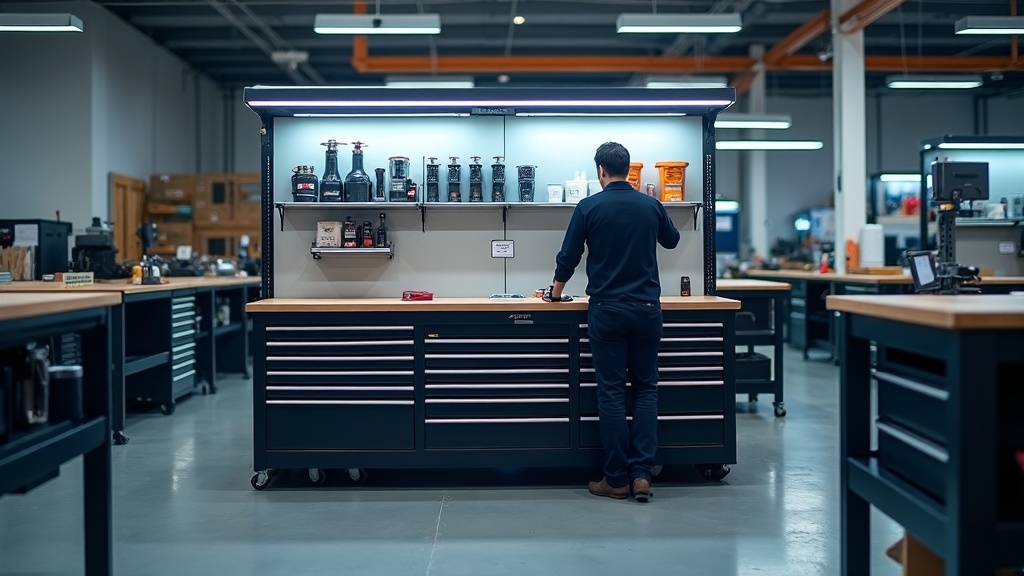
| Model | Configuration | Lift Capacity | Height Range | Key Feature |
|---|---|---|---|---|
| QuatreX Electric | Dual motor | 150kg per column | 650–1,280mm | Industrial-grade; full Treston accessory compatibility |
| QuatreX ESD | Dual motor | 150kg per column | 650–1,280mm | IEC 61340-5-1 compatible; anti-static work surface |
| TED Electric Desk | Dual motor | 80kg per column | 650–1,250mm | Office/commercial focus; lower noise |
| Treston Industrial (electric) | Dual/triple motor | 150–200kg per column | Custom | Project-spec for heavy industrial applications |
7. What to Do Next
For MOM WSH compliance: Start with a documented ergonomic risk assessment of your standing workstations. Identify the duration of standing, tasks performed, and operator height range — this becomes the specification input for the height-adjustable workbench.
For open-plan office or commercial fit-out: Engage the interior designer and WSH consultant early. Electric height-adjustable workbenches require electrical provisioning — specify power outlet and data point locations relative to each bench position.
For packing or logistics station upgrade: Calculate the shift-change time cost. If your operation rotates operators through fixed-height stations, the time spent adjusting to each operator’s ergonomic requirement is a measurable productivity loss. An electric bench with memory presets eliminates this.
Related Articles:
Commercial Offices | Standing Desks & Ergonomics | Industrial Workbenches
Y K Toh Marketing (S) Pte Ltd
Tel: (65) 6542 3232 | enquiry@yktoh.com | yktoh.com


