


Quick answer
Industrial Workbench Storage: Drawer Units, Bin Rails & Overhead Shelving in : The Complete Guide (2026) is important because this guide covers drawer units, bin rails, overhead shelving, and overhead tool panels — the complete storage ecosystem for industrial workbenches in Singapore. The practical goal is to improve safety, productivity, and buying confidence before selecting equipment or requesting a quotation.
Practical next steps
- Confirm the load, workspace, workflow, and safety requirements.
- Compare the product fit against daily operating conditions, not just catalogue specifications.
- Speak with YK Toh for sizing, compatibility, and quotation guidance.
Key Considerations When Selecting Drawer Units
- Match drawer load rating to the weight of items to be stored; never exceed rated capacity
- Choose drawer dividers or foam inlays to prevent component movement and damage
- Opt for 100% extension drawers for full access to stored items
- Select ESD-safe models when storing electronic components or static-sensitive parts
- Consider drawer locking mechanisms for secure storage of valuable or hazardous items
- Ensure drawer fronts are labelled clearly for fast item location and inventory accuracy
A workbench without storage is a workbench that is constantly being cleared, reorganised, and cleared again. In any Singapore industrial operation — electronics assembly in Jurong, logistics packing in Changi, automotive workshop in Ubi — the single biggest cause of workstation surface clutter is the absence of a properly designed storage ecosystem beneath, above, and around the bench.
| Drawer Configuration | Max Load per Drawer (kg) | Drawer Height (mm) | Typical Application |
|---|---|---|---|
| Single drawer | 200 – 400 | 75 – 150 | Light tools, small parts, samples |
| 3-drawer unit | 150 – 300 | 75 – 150 | Component storage, workbench side table |
| 5-drawer unit | 100 – 250 | 50 – 150 | Mixed small parts, electronics, precision tools |
| 7+ drawer unit | 50 – 150 | 25 – 100 | Very small components, fasteners, SMD parts |
The economics are straightforward: a workbench surface occupied by tools, components, and consumables is a workbench surface that cannot hold a workpiece. Every centimetre occupied by a pile of tools is a centimetre of productive capacity surrendered to storage inefficiency. In Singapore’s high-labour-cost environment, this compounds across every shift, every operator, and every workstation.
The Storage Hierarchy: Planning What Goes Where
Derived from LEAN manufacturing — items used most frequently should require the least effort to access:
Zone 1 — Primary reach (0–400mm): Hand tools, frequently accessed components, consumables used more than once per hour. Stored in drawer units beneath the bench surface or on bin rails at bench-top height.
Zone 2 — Secondary reach (400–700mm): Less common tools, spare parts, documentation. Stored in lower drawers or on mid-height shelving.
Zone 3 — Extended reach (700mm+): Infrequently used items, archival records, backup stock. Stored in overhead shelving above the bench.
Drawer Units: Under-Bench Storage

Full-extension drawers: Essential for frequently accessed items — allows access to the full drawer depth from the front. Perforated drawer fronts: Allow visual identification of contents without opening — valuable in high-mix operations (electronics assembly, kitting). Central locking: Secures all drawers simultaneously; essential where valuable tools, precision instruments, or expensive components are stored. Foam inserts: Custom-cut foam with shaped cut-outs for precision tools — reduces search time, prevents tool damage, provides visual check that all tools are present.
Bin Rails and Bins: Above-Bench Storage

Every bin in a high-efficiency workstation should be labelled: component name, part number (for traceability), and minimum stock level (for kitting replenishment trigger). A well-designed bin system should allow any operator to find a specific item in under 10 seconds without asking a colleague.
Overhead Shelving

Cable Management and Power Rails

LED Task Lighting
Singapore’s JTC factory buildings commonly have inadequate ambient lighting at bench height. Overhead fluorescent or metal halide creates shadows and glare that reduce effective illuminance for precision work.
Specification: Minimum 300 lux (500–1,000 lux for precision work); 4,000K neutral white or 5,000K cool white for colour-critical tasks; IP20 for controlled environments, IP65 for wet or cleanroom; dimmable preferred. Swing-arm mounted LED lights are preferred because the light can be repositioned as the task changes without creating glare in the operator’s eyes.
Integrated Storage Ecosystem: Putting It Together
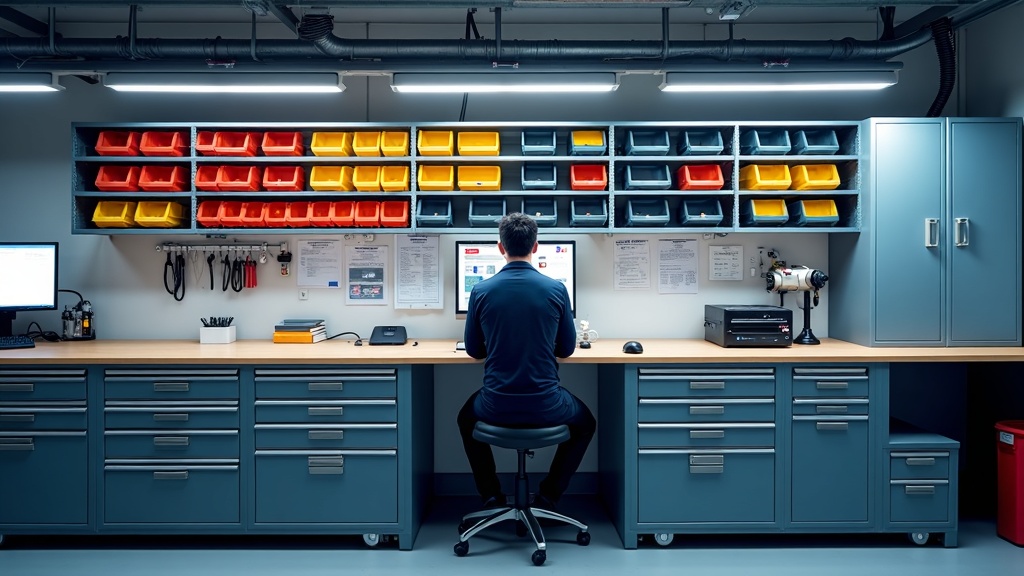
Consistent mounting system: All accessories use the same structural profile. Load plan: Map storage items to each zone and confirm specified components can carry actual loads — verify before ordering. Colour coding and identification: A well-designed storage system should allow any operator to find a specific item in under 10 seconds without asking a colleague.
Common Mistakes in Workstation Storage Specification
Mistake 1: Specifying drawers without verifying slide capacity against actual loads — count the actual weight of the heaviest drawer load, add 50%, and specify to that rating.
Mistake 2: Too much overhead storage. Keep overhead to items used less than once per day — heavy or bulky items overhead create safety and ergonomic hazards.
Mistake 3: No cable management specified. Add enclosed cable tray as a baseline item — the cost is low and the operational improvement is immediate.
Mistake 4: Incompatible accessory mounting systems. Verify mounting compatibility before ordering — different hole patterns or slot widths require custom fabrication.
Frequently Asked Questions
Q: What drawer slide capacity do I need for an industrial workbench in Singapore?
A: Calculate the maximum anticipated load for your heaviest drawer and multiply by 1.5. For most Singapore industrial applications, 75kg-rated drawer slides is the minimum; 100kg-rated preferred for heavy tool storage.
Q: Can third-party accessories be mounted on a Treston workbench?
A: Treston’s 40mm slot-grid profile is proprietary — Treston accessories mount directly to Treston benches. Third-party accessories using standard 10mm grid perforated panels can be mounted using adapters, but native mounting compatibility is only within the Treston ecosystem.
Q: What cable management is required for MOM WSH compliance?
A: MOM WSH guidelines require that cables be managed to prevent trip hazards. An enclosed cable tray beneath the bench surface routing cables to the floor or wall is the standard specification. Loose cables on the floor are a direct inspection finding.
Q: How do I design a storage system for rapid changeover in mixed-product operations?
A: A bin rail system with colour-coded, labelled bins and a storage map posted at the workstation allows operators to locate any item in under 10 seconds and change configuration in under 2 minutes — standard for Singapore contract manufacturing operations.
Next Steps
Designing a new workstation storage system, upgrading an existing configuration, or looking to improve throughput through better organisation? Our team provides storage system specification and installation for Singapore industrial operations.
Related Articles:
Industrial Storage Systems | Industrial Workbenches | Bin Rails & Storage Bins | Overhead Shelving
Y K Toh Marketing (S) Pte Ltd
Tel: (65) 6542 3232 | enquiry@yktoh.com | yktoh.com


