


Quick answer
Packing Workstations for Food & Beverage & Cold Storage in : The Complete Guide (2026) is important because singapore's position as a regional food logistics hub demands specialist packing workstations. The practical goal is to improve safety, productivity, and buying confidence before selecting equipment or requesting a quotation.
Practical next steps
- Confirm the load, workspace, workflow, and safety requirements.
- Compare the product fit against daily operating conditions, not just catalogue specifications.
- Speak with YK Toh for sizing, compatibility, and quotation guidance.
Singapore’s position as a regional food logistics hub — anchored by Changi Airfreight’s perishable cargo capabilities, Jurong Fishery Port, and Tuas Megaport’s cold chain infrastructure — creates demanding requirements for packing workstations in food & beverage (F&B) and cold storage operations.
Key Requirements for Food/Beverage Cold Storage Packing Stations
- All workbenches in chilled zones must be constructed from stainless steel to prevent corrosion and bacterial growth
- Install anti-condensation heating elements on bench surfaces to prevent product freezing during handling
- Use moisture-resistant label stock and cryogenic-rated adhesive for sub-zero environments
- Implement HACCP-compliant SOPs for all packing activities including temperature logging at each station
- Install non-slip flooring around packing stations to prevent slips in condensation-prone cold zones
- Provide insulated personal protective equipment (gloves, aprons) to prevent frostbite during extended handling
For logistics operators, food manufacturers, and distribution companies, the packing workstation must satisfy NEA environmental public health requirements, SFA cold chain regulations, and MOM workplace safety standards simultaneously.
The Singapore Food Cold Chain Context
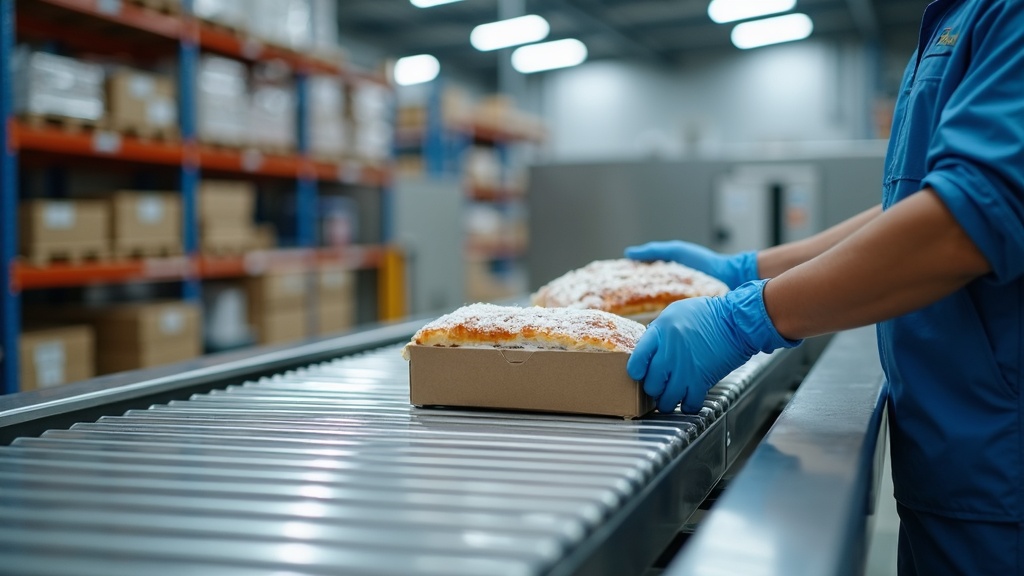
Singapore imports more than 90% of its food supply. Temperature zones span ambient (15–25°C), chilled (0–4°C), and frozen (−18°C to −25°C) — each placing different demands on the workstation. Under SFA’s cold chain management guidelines, the cold chain must not be broken between production and retail display.
Stainless Steel: The Mandatory Work Surface for F&B Packing
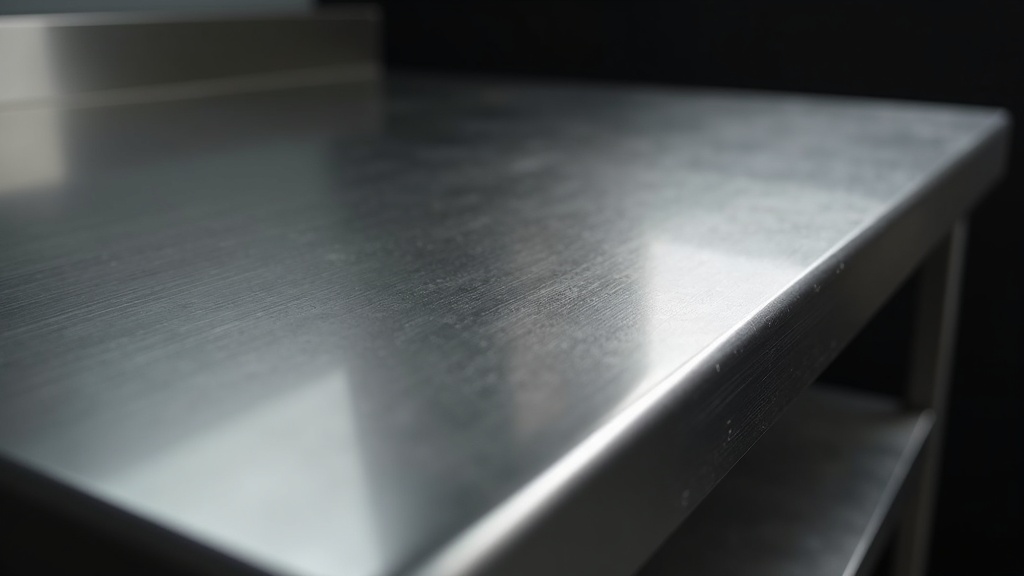
Stainless steel is non-negotiable: non-porous and smooth for cleanability; corrosion-resistant in chilled and frozen environments; durable across the full temperature range; compliant with FSMA-aligned international food safety frameworks.
| Grade | Typical Use |
|---|---|
| Type 304 | General food packing, chilled storage — standard food-grade |
| Type 316 | Seafood, raw meat, high-corrosion — molybdenum-added |
| Type 430 | External surfaces only — not for food contact |
Cold Storage Packing: Ergonomic Challenges at Low Temperatures
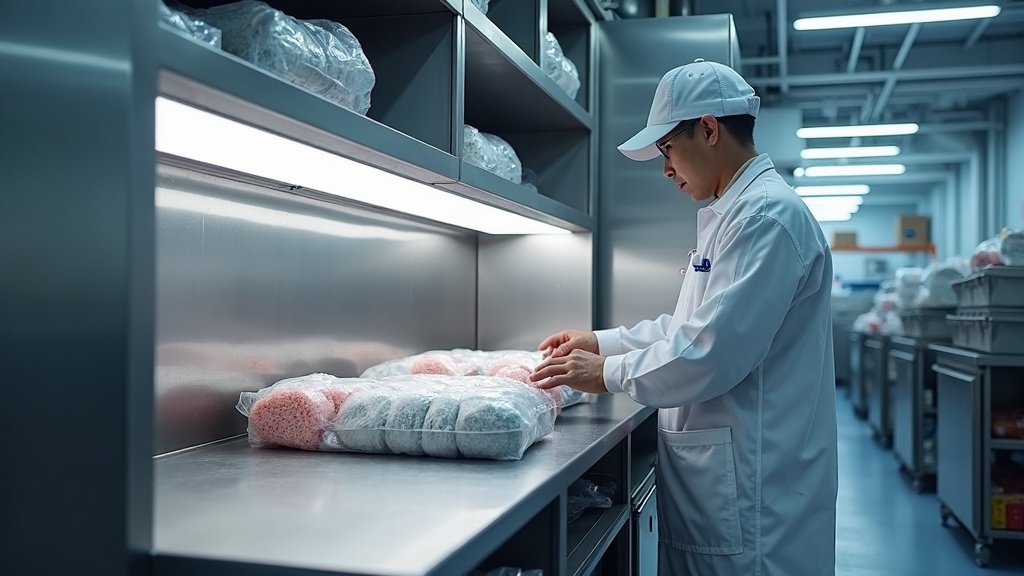
Below 10°C, blood flow to the hands reduces significantly, impairing fine motor control. MOM references ACGIH TLVs: maximum 30–45 minutes continuous exposure in frozen storage (−18°C to −25°C); 60–90 minutes in chilled storage (0–4°C).
Regulatory Framework
NEA: Environmental Public Health (Food Hygiene) Regulations require smooth, impervious, non-corrosive food-contact surfaces — stainless steel with coved corners and fully welded seams. No exposed fasteners on food-contact surfaces.
SFA: Cold chain integrity must be maintained through packing. Workstations must support rapid packing and be maintainable to food safety standards at operating temperatures.
MOM WSH: Cold storage is a hazardous work environment. Documented cold stress risk assessment required, with enforced maximum continuous exposure limits and mandatory warm break protocols.
Configuring a Cold Storage Packing Workstation
Ambient / Chilled Food Packing (0°C to 15°C)
| Component | Specification |
|---|---|
| Work surface | Type 304 stainless steel, 1.5mm minimum |
| Frame | Stainless steel or hot-dip galvanised steel |
| Height adjustment | Electric height adjustment (preferred) |
| Roller conveyor | Stainless steel rollers, cryogenic-rated |
| Anti-fatigue mat | Cold-rated rubber, tested to −25°C |
| Lighting | IP65 LED fixture, minimum 500 lux |
Frozen Storage Packing (−18°C to −25°C)
| Component | Specification |
|---|---|
| Work surface | Type 304 stainless steel, 2mm thickness |
| Frame | Stainless steel, fully welded — no bolt-together |
| Height adjustment | Manual crank (electrical may fail at temperature) |
| Roller conveyor | Stainless steel, cryogenic-rated, minimal moving parts |
| Anti-fatigue mat | Cryogenic-rated composite mat, tested to −25°C |
| Lighting | IP67 LED fixture, sealed, minimum 500 lux |
Common Mistakes
Mistake 1: Specifying standard industrial “stainless steel” that uses Type 430 for the frame. Verify ALL food-contact surfaces — including bench legs — are Type 304 or Type 316.
Mistake 2: Bolt-together frames in frozen storage. Ice accumulates in joints when moved between frozen and ambient environments. Specify fully welded stainless steel frames for frozen storage.
Mistake 3: Standard anti-fatigue mats below −10°C. They crack and become hazardous. Specify cryogenic-rated composite matting.
Mistake 4: Not coordinating with NEA licensing timeline. Engage your NEA-licensed hygiene consultant during specification — remediation after an NEA inspection flag is more expensive.
Treston Food-Grade Packing Workstations in Singapore

Frequently Asked Questions
Q: Do all food packing workstations in Singapore need to be stainless steel?
A: Under NEA’s Food Hygiene Regulations, all food-contact surfaces must be smooth, impervious, and easily cleanable. Stainless steel Type 304 is the standard and most widely accepted specification.
Q: What are the MOM cold storage work exposure limits in Singapore?
A: MOM’s WSH guidance references ACGIH TLVs: maximum 30–45 minutes continuous in frozen storage (−18°C to −25°C); 60–90 minutes in chilled storage (0–4°C). Documented exposure monitoring and mandatory warm breaks required.
Q: Can Treston configure stainless steel packing workstations for cold storage use in Singapore?
A: Yes. Treston’s stainless steel range includes food-grade workbenches with fully welded Type 304/316 construction and coved corner transitions suitable for NEA-regulated food premises. Available through authorised Singapore distributors.
Next Steps
If you are setting up a new F&B packing operation, upgrading your cold chain workstation line, or preparing for NEA or SFA licensing inspection, our team provides food-grade workstation specification, layout design, and installation for Singapore F&B and cold storage operations.
Related Articles:
Packing Workbenches | Cold Storage Racking | E-Commerce 3PL Operations
Y K Toh Marketing (S) Pte Ltd
Tel: (65) 6542 3232 | enquiry@yktoh.com | yktoh.com


