


Quick answer
Packing Workstations for E-Commerce & 3PL Operations in : The Complete Guide (2026) is important because in e-commerce and 3PL operations, the packing station is where throughput meets cost. The practical goal is to improve safety, productivity, and buying confidence before selecting equipment or requesting a quotation.
Practical next steps
- Confirm the load, workspace, workflow, and safety requirements.
- Compare the product fit against daily operating conditions, not just catalogue specifications.
- Speak with YK Toh for sizing, compatibility, and quotation guidance.
Key Planning Considerations for E-Commerce Packing Workstations
- Design station layout to follow a straight or U-shaped pick-and-pack flow to minimize walking distance
- Install parcel measurement stations upstream to auto-generate shipping labels and reduce handling steps
- Allocate dedicated void fill stations with automatic dispensers to maintain consistent pack quality
- Implement zone picking or wave picking strategies to reduce travel time for pickers in large warehouses
- Use conveyor-fed packing stations for high-volume SKUs to eliminate manual carrying of parcels
- Configure station throughput targets and monitor pack-per-hour rates via WMS dashboard for performance management
Singapore’s e-commerce and 3PL sector operates at a pace that has fundamentally changed what a packing workstation must deliver. A packing station is not a workbench with a label printer next to it — it is a throughput-optimised workstation designed around a single metric: parcels completed per operator per hour.
| Component | Specification | Recommended Dimension | Notes |
|---|---|---|---|
| Work surface height | Fixed or adjustable | 750-900mm fixed; 650-1,300mm adjustable | Adjustable preferred for mixed operator height ranges |
| Work surface depth | Min 600mm | 600-800mm | Must accommodate packing tray and parcel dimensions |
| Load capacity per station | Min 150kg static | 150-300kg | Accounts for heavy parcels, void fill equipment |
| Under-shelf drawer units | 2-4 drawers per station | 100-200kg per drawer | For tape, labels, void fill, documents |
| Overhead shelving | Above workbench for supplies | 300-500mm deep, 400-600mm above work surface | Reduces walking distance to fetch supplies |
| Integrated power | 4-6 outlets per station | 13A, 230V Singapore standard | For label printers, scanners, tape guns |
At Singapore labour rates (S$18–S$22/hour), a 10-second reduction in cycle time per parcel in a 50-operator, 2-shift fulfilment centre translates to approximately S$75,000–S$120,000 in annual labour savings. Every centimetre of unnecessary reach, every unnecessary trip to retrieve packing materials, and every moment spent adjusting to an incorrectly positioned scale adds up across hundreds of parcels per shift.
The Economics of Packing Station Design in Singapore
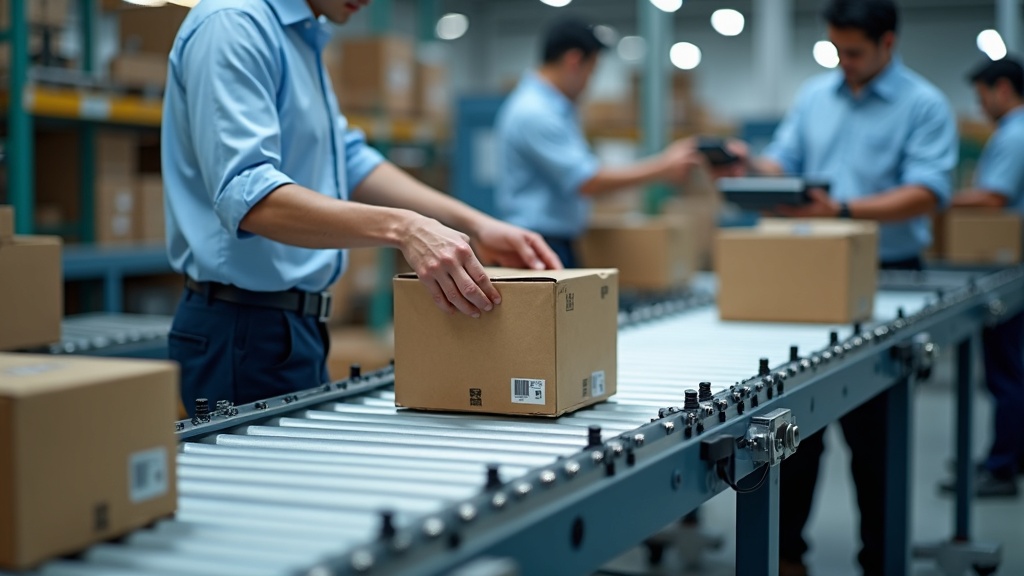
Core Components of an Optimised Packing Workstation
Roller Conveyor Section
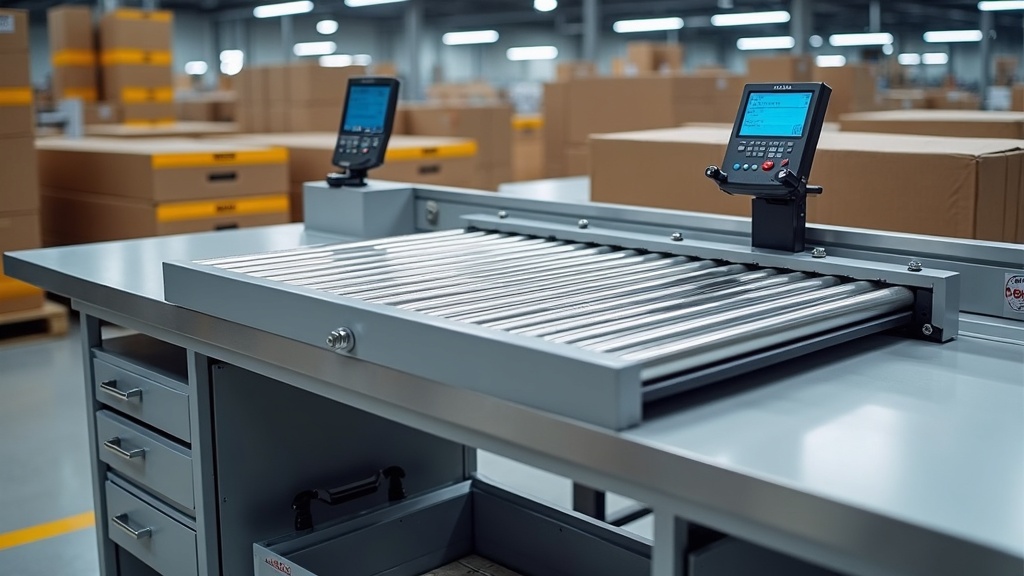
The defining feature of a dedicated packing workstation. A parcel on a smooth surface requires significant sliding force; a parcel on properly specified rollers requires approximately 10% of that force. Specification: 30–50mm steel or stainless steel rollers, 50–75mm spacing for parcels up to 30kg, 300–600mm section length, flush with or slightly below work surface height.
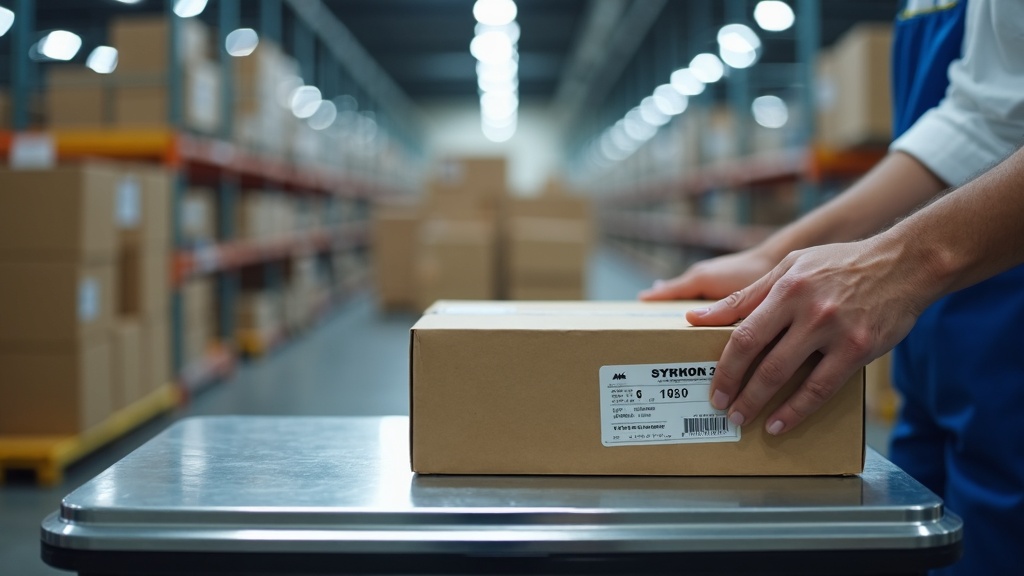
Integrated Weighing
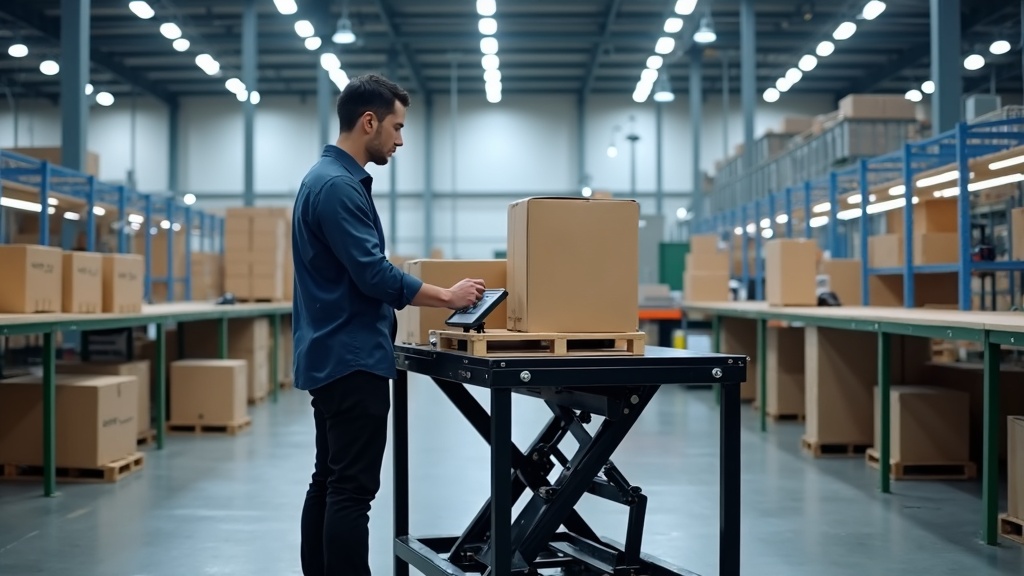
Height Adjustability
Under-Bench Storage and Power
Drawer units (minimum two — one for void fill, one for tape and documentation) keep materials within arm’s reach without occupying the work surface. A trunking-style power rail with individual fused switched socket outlets (13A, Singapore SS 145 standard) — minimum 4 outlets per station — for label printer, barcode scanner, HHT charger, and heat sealer. Cable clips or trays route cables away from the work surface to prevent trip hazards.
Singapore Regulatory Context
MOM WSH (Risk Management) Regulations: Packing stations are repetitive motion environments. Employers must implement engineering controls (height-adjustable workstations, anti-fatigue mats, task rotation) before relying on administrative controls alone. Repetitive reaching, prolonged standing, and repetitive wrist and forearm motion during label application are the key ergonomic risk factors.
NEA EPH Regulations: For fulfilment centres handling food products in food-adjacent facilities, work surfaces must be cleanable to food hygiene standards — stainless steel or non-porous laminate. Floor areas must be kept free of debris and condensation.
Workplace Lighting: MOM guidelines specify minimum 300 lux at the work surface for general tasks and 500 lux for label reading and quality inspection. Most Singapore industrial buildings have adequate ambient lighting at floor level but insufficient lighting at bench height — making overhead task lighting a practical requirement.
Configuring a Packing Workstation for Singapore E-Commerce
Baseline Configuration: 1,800mm × 750mm work surface; bolt-together steel frame (500kg rated); 400mm × 600mm stainless steel roller section; 30kg × 10g integrated scale (Ethernet-connected to WMS); Zebra ZT411 label printer bracket-mounted; two-drawer under-bench storage; 4-outlet fused power rail; LED task light at 500 lux minimum; anti-fatigue mat; manual crank height adjustment (650–1,200mm range) for multi-user stations.
Enhanced Configuration (High-Throughput / Premium 3PL): 2,000mm × 800mm steel plate work surface; electric height adjustment with memory presets for 4 operators; powered conveyor section for large/heavy parcels; 50kg × 20g scale with auto-print trigger; fixed in-counter barcode scanner; vacuum pick-and-place for fragile item packing; full Ethernet/IP WMS integration.
Common Mistakes in Packing Workstation Specification

Mistake 1: Fixed-height bench in a multi-user environment. A bench at 900mm is ideal for a 1.75m operator and inadequate for a 1.55m operator. Specify height-adjustable.
Mistake 2: No roller section. This is the highest-return investment in a packing station. Always include it.
Mistake 3: Shared scale creating a bottleneck. An integrated scale at each station removes dependency and walking time.
Mistake 4: No cable management. Loose cables on a wet or dusty floor create a trip hazard and maintenance problem.
Treston Packing Workstation Systems in Singapore
Frequently Asked Questions
Q: What is the ROI on an electric height-adjustable packing station?
A: At Singapore labour rates, a height-adjustable station that improves operator throughput by even 5% (a conservative estimate for multi-user stations) pays back its additional cost in 3–6 months. The ergonomic benefit — reduced MSD risk and lower turnover — provides additional compounding return.
Q: How many parcels per hour can one packing operator process?
A: At an optimised station with roller section, integrated scale, and label printer: 80–120 parcels per hour depending on parcel size and packaging complexity. At a basic fixed bench with no optimisation: 40–60 parcels per hour.
Q: What MOM WSH requirements apply to e-commerce packing stations?
A: WSH (Risk Management) Regulations require documented risk assessments for repetitive motion and prolonged standing hazards, with engineering controls (height-adjustable workstations, anti-fatigue mats) implemented before relying on administrative controls (job rotation) alone.
Q: Does Treston offer packing workstations configured for Singapore e-commerce?
A: Yes. Treston’s modular range including the Lifting Platform, roller sections, drawer units, and integrated power rails can be configured as a complete packing workstation system through authorised Singapore distributors with layout design, specification support, and installation.
Next Steps
Setting up a new fulfilment centre, upgrading your existing packing station line, or looking to improve throughput and ergonomics at your 3PL operation? Our team provides packing workstation specification, layout design, and installation for Singapore e-commerce and logistics operations.
Related Articles:
Packing Workbenches | Warehouse Station Design | Electric Pallet Trucks
Y K Toh Marketing (S) Pte Ltd
Tel: (65) 6542 3232 | enquiry@yktoh.com | yktoh.com


