


The case for electric height-adjustable workbenches as ergonomic interventions is not a marketing claim — it is a conclusion supported by a substantial body of occupational health research. The relationship between prolonged standing and musculoskeletal disorders (MSDs), cardiovascular strain, and lower back pain is documented across multiple peer-reviewed studies and is referenced explicitly in Singapore’s Ministry of Manpower (MOM) workplace safety and health guidelines.
For Singapore employers — particularly those operating industrial workstations, precision assembly environments, and commercial operations where the WSH (Risk Management) Regulations apply — the question is no longer whether height-adjustable workstations are beneficial. It is whether the financial return on investment in adjustable benches is sufficient to justify the higher unit cost versus a fixed-height alternative. The answer, for most Singapore operations, is yes.
The Ergonomic Case: What Prolonged Standing Does to the Body
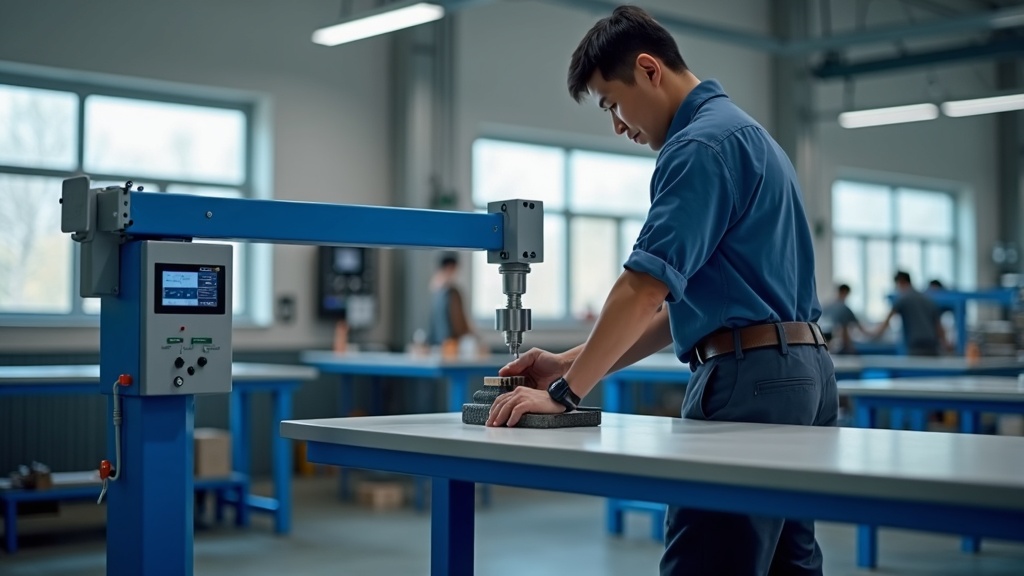
Extended standing — standing for more than 2 hours per shift without opportunity to sit or vary posture — is associated with a measurable increase in MSD risk.
Musculoskeletal load: When standing without movement, the body’s postural muscles — particularly the lumbar erector spinae, gluteus medius, and soleus — sustain static loading that leads to fatigue and, over time, cumulative strain. The intervertebral disc pressure in the lumbar spine is approximately 23% higher during standing than during reclined sitting.
Cardiovascular effects: Static standing promotes blood pooling in the lower extremities, increasing venous return load on the heart. Studies document increased risk of varicose veins, chronic venous insufficiency, and cardiovascular strain in workers who stand for extended periods.
Singapore workforce implications: The MOM’s WSH (Risk Management) Regulations require employers to assess risks arising from work organisation, including prolonged standing. An employer who identifies prolonged standing as a risk factor — and does not implement engineering controls (sit-stand workstations) — is not fulfilling the “reasonably practicable” standard required under the WSH Act.
Singapore MOM WSH Compliance and Height-Adjustable Workstations
Under Section 12 of the WSH Act, every employer must take reasonably practicable steps to ensure the safety and health of employees. A risk assessment that identifies prolonged standing as a hazard — without implementing the engineering control available to address it — creates legal exposure. In the event of a MOM inspection following a reported MSD claim, the absence of controls for an identified risk would be treated as a deficiency.
For any workstation where an operator stands for more than 2 hours per shift: A height-adjustable workbench (manual crank or electric) is the appropriate engineering control.
For any workstation shared by multiple operators of different heights: A height-adjustable bench with memory presets is the appropriate specification.
The Financial Case: ROI on Electric Height-Adjustable Workbenches
The return on investment for height-adjustable workbenches can be quantified across three categories:
Category 1: Reduced Absenteeism and MSD-Related Costs. A height-adjustable bench that reduces MSD incidence by even one case per year in a 20-operator facility has a payback period of less than 18 months at Singapore equipment prices.
Category 2: Improved Productivity. Operators at correctly specified workstations work more efficiently. Industry benchmarks from configurable workstation deployments in Singapore suggest a 5–12% improvement in task cycle efficiency.
Category 3: Reduced Turnover and Recruitment Costs. Operations that improve the physical ergonomics of workstations reduce voluntary turnover. At Singapore’s current logistics labour turnover rates, even a modest turnover reduction of 10% translates to significant recruitment and training cost savings.
Electric vs Manual Height Adjustment
| Feature | Manual Crank | Electric Motor |
|---|---|---|
| Cost premium | S$400–S$800 | S$800–S$1,500 |
| Speed of adjustment | 5–15 seconds | 3–8 seconds |
| Memory presets | Not available | Available (4–8 presets) |
| Best for | Single-user; budget ops | Multi-user; frequent changes |
| Reliability | Very high | High |
| Installation | No electrical work | Licensed electrician for hard-wired |
Singapore recommendation: For any workstation shared by more than one operator, or any workstation where height will be changed more than twice per shift, the electric motor specification with memory presets is the correct choice.
Key Specifications for Electric Height-Adjustable Workbenches
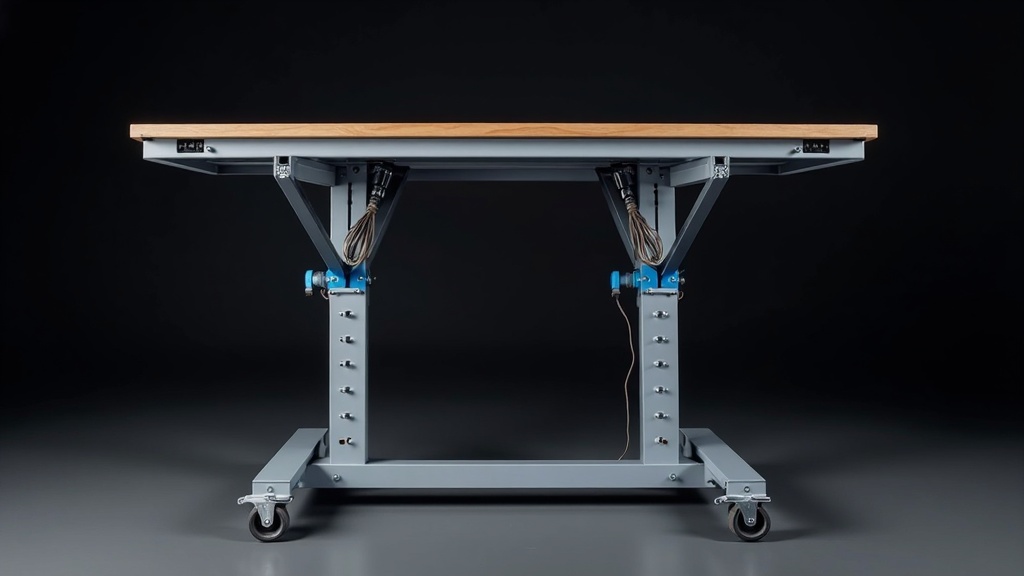
Motor and Lifting System
| Specification | Minimum Standard | Recommended |
|---|---|---|
| Motor type | Single motor | Dual motor (for loads above 80kg per column pair) |
| Lift capacity | 50kg per column pair | 100–150kg per column pair |
| Height range | 650–1,250mm | 600–1,280mm (full sit to full stand) |
| Adjustment speed | 25mm/second | 35–40mm/second |
| Anti-collision | Not required | Integrated sensor — required in shared workspaces |
| Memory presets | 2 presets | 4–8 presets (for multi-operator use) |
Anti-Collision Systems
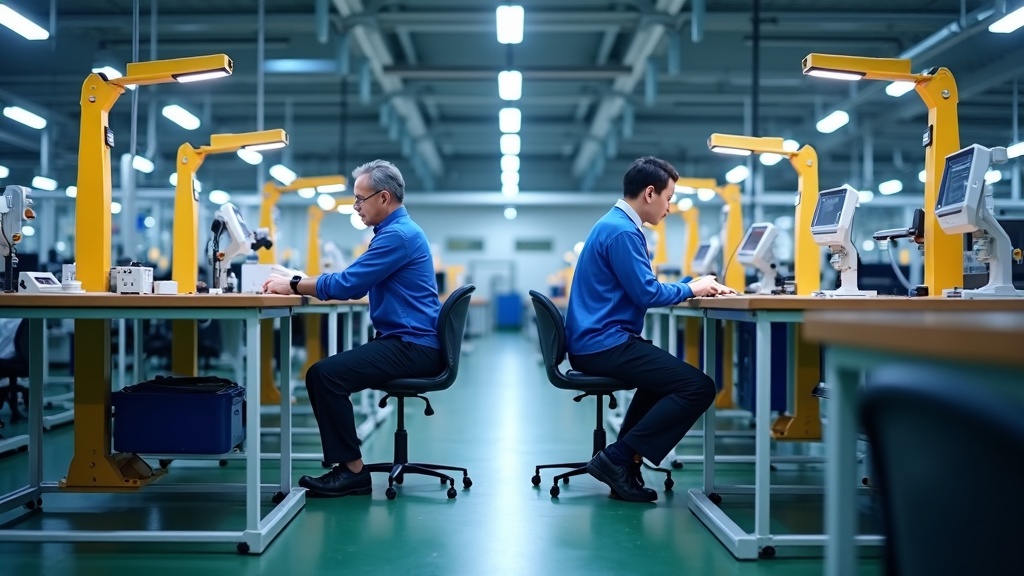
When two height-adjustable benches are used in a shared workspace, their columns can collide during simultaneous adjustment. Integrated anti-collision sensors detect resistance and immediately stop or reverse the motor. This is an essential safety feature in any installation where benches are positioned within 1.5 metres of each other.
The Ergonomic Case: Sit-Stand Optimisation
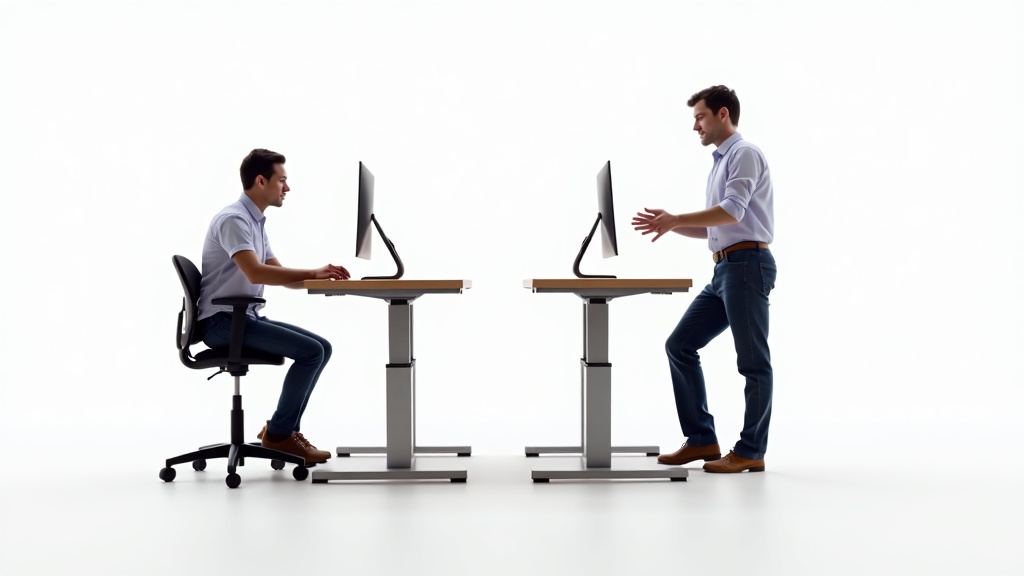
The optimal configuration is a sit-stand cycle — alternating between standing and sitting every 30–60 minutes. This alternation reduces sustained static load on the lumbar spine, promotes venous return, and reduces fatigue. An electric height-adjustable bench with memory presets allows each operator to alternate between their seated and standing preset positions without manual adjustment.
Industry Applications in Singapore
Precision Assembly and Electronics Manufacturing: Height adjustment allows the operator to set the bench to seated height for detailed inspection and soldering, raise to standing height for larger assembly tasks, and lower for close visual inspection — without requiring a separate seated station.
Laboratory and Quality Control: QC laboratories in Singapore — food testing, materials testing, pharmaceutical QC — benefit from height-adjustable benches that accommodate different operators and different analytical tasks on the same workstation.
Common Mistakes in Height-Adjustable Workbench Specification
Mistake 1: Specifying single-motor units for loads that exceed their capacity. For any application where tools, fixtures, or heavy components will be placed on the bench, specify a dual-motor system rated above the anticipated maximum load.
Mistake 2: Specifying without memory presets in multi-operator environments. At 15 seconds per manual adjustment, this is a cumulative productivity loss. Memory presets are not optional in multi-operator environments.
Mistake 3: No cable management specified. The moving cable on a height-adjustable bench is the most common failure point. Specify a bench with enclosed cable tray or telescoping cable guide.
Mistake 4: Ignoring floor levelling. Height-adjustable benches must be perfectly level. If the floor is uneven and the bench feet cannot be individually adjusted, the bench will rack under load — causing premature motor failure.
Treston Electric Height-Adjustable Workbenches in Singapore
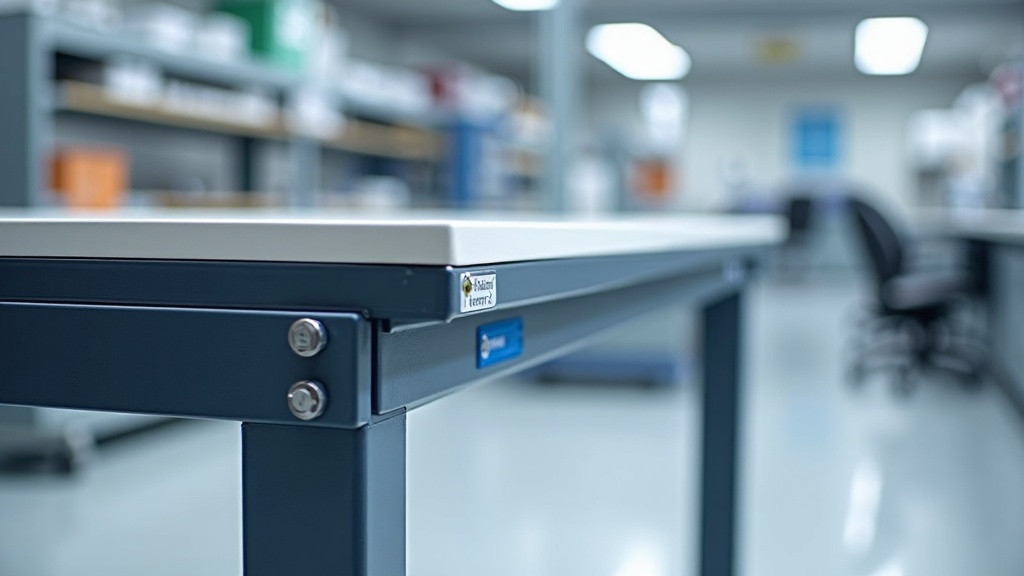
Treston’s QuatreX range is the reference specification for electrically height-adjustable workstations in Singapore’s industrial and professional environments.
- Dual motor drive with 150kg per column pair load capacity
- Digital control panel with 4-operator memory preset storage
- Anti-collision system with force-limiting sensors
- Integrated cable management as standard
- 40mm slot-grid structural profile compatible with full Treston accessory ecosystem
- IEC 61340-5-1 compatible versions available for ESD environments
Singapore-authorised distributors provide site assessment, layout design, installation, and after-sales support.
Frequently Asked Questions
Q: What does MOM require for workstations where operators stand for extended periods in Singapore?
A: Under the WSH (Risk Management) Regulations, employers must conduct a risk assessment for prolonged standing. MOM’s ergonomics guidelines specify sit-stand workstations as the primary engineering control. A height-adjustable workbench — allowing the operator to alternate between sitting and standing — is the recommended control measure.
Q: How much productivity improvement can we expect from electric height-adjustable benches?
A: Based on industry benchmarks for similar Singapore operations, a 5–12% improvement in task cycle efficiency is typical. The improvement is most pronounced in multi-user environments and in operations with variable task types.
Q: What is the lifespan of an electric height-adjustable bench in a Singapore industrial environment?
A: A quality electric height-adjustable bench has an expected mechanical lifespan of 8–12 years for the frame and lifting columns. Motors and electronic control systems typically last 5–8 years before component refresh is required.
Q: Can electric height-adjustable benches be used in ESD environments?
A: Yes — with appropriate specification. Treston’s QuatreX range includes ESD-compliant versions that maintain IEC 61340-5-1 compliance through the height-adjustment mechanism.
Next Steps
If you are implementing ergonomic controls at your Singapore operation, addressing a MOM compliance notice, or upgrading workstations to sit-stand configuration, our team provides electric height-adjustable workstation specification, layout design, and installation.
Related Articles:
Electric Height-Adjustable Workbenches | MOM WSH Compliance | Heavy Duty Workbenches
Y K Toh Marketing (S) Pte Ltd
Tel: (65) 6542 3232 | enquiry@yktoh.com | yktoh.com


