Quick answer
Housekeeping and 5S Methodology in Warehouses: A Practical Guide to Cutting Waste and Boosting Safety is important because 5S is the foundation of warehouse operational excellence — it reduces waste, improves safety, and enables every other improvement initiative. The practical goal is to improve safety, productivity, and buying confidence before selecting equipment or requesting a quotation.
Practical next steps
- Confirm the load, workspace, workflow, and safety requirements.
- Compare the product fit against daily operating conditions, not just catalogue specifications.
- Speak with YK Toh for sizing, compatibility, and quotation guidance.
Housekeeping and 5S Methodology in Singapore Warehouses: A Practical Guide to Cutting Waste and Boosting Safety
Introduction
Every warehouse manager in Singapore has seen it: aisles cluttered with empty pallets, stock piled in unmarked zones, forklifts parked in emergency routes. It is not just ugly — it is expensive, unsafe, and quietly bleeding productivity.
The fix is not a new WMS or another piece of handling equipment. It is housekeeping. Specifically, structured housekeeping built on the 5S methodology — a system that has been proven in manufacturing for decades and is directly applicable to warehouse operations in Singapore’s demanding industrial landscape.
This guide walks through each of the five S steps, shows how they apply specifically to Singapore warehouse operations, and explains how a disciplined 5S programme supports your BizSAFE certification and MOM WSH compliance obligations.
What Is 5S?
5S is a workplace organisation methodology derived from Japanese manufacturing. It structures housekeeping into five sequential steps, each building on the last:
- Sort — Separate necessary from unnecessary items
- Set in Order — Arrange for efficient use
- Shine — Clean and inspect regularly
- Standardise — Document and sustain the first three S
- Sustain — Maintain discipline over time
Originally developed for manufacturing floors, 5S translates directly to warehouse environments — from receiving docks to racking aisles to dispatch zones. In Singapore’s tightly managed industrial premises, where space is expensive and MOM inspections are a regular reality, 5S is not optional. It is operational infrastructure.
The Five S Steps in a Singapore Warehouse Context
Step 1: Sort (Seiri)
Sort means removing everything from the workspace that does not belong there. In a Singapore warehouse, this typically means:
- Empty or broken pallets taking up valuable floor space
- Obsolete stock still sitting in racking positions
- Abandoned equipment, hand trucks, or drums in aisles
- Documents and packaging waste accumulating in corners
The business case is clear: JTC Corporation reports that杂物 clutters can reduce effective floor utilisation by up to 20% in Singapore industrial units. Every unused pallet,占用一个真实的存储位置.
Practical action: Conduct a full aisle-by-aisle audit. Label every item as Keep, Relocate, or Remove. Set a removal deadline — if it has not moved in 30 days and is not seasonal stock, it goes.
Step 2: Set in Order (Seiton)
Once the unnecessary is removed, arrange the remainder for maximum efficiency.
Key considerations for Singapore warehouses:
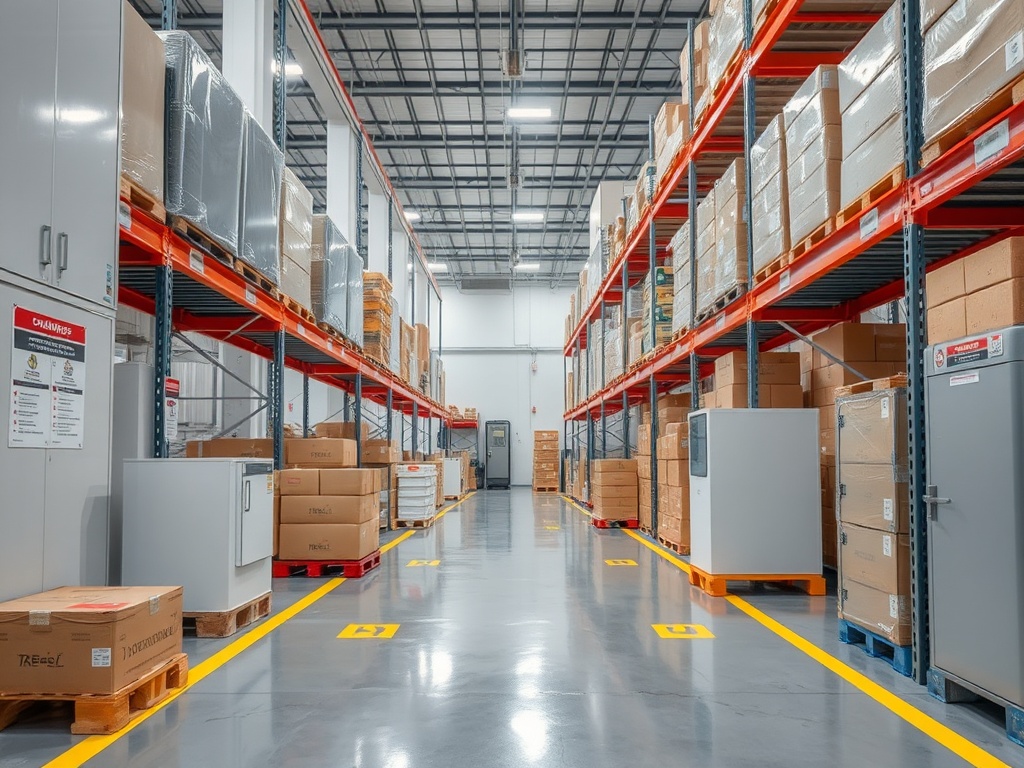
- Racking zones should have clear floor markings — yellow for forklift paths, red for emergency equipment access, green for picking zones
- Pallet positions should be numbered and mapped in your warehouse layout — operators should not need to search for a slot
- Loading bay areas must comply with SCDF fire code requirements — a minimum 1.5m clearance maintained at all times
- Forklift parking bays designated and signed — not in aisles, not blocking racking access
Under MOM’s WSH (Workplace Safety and Health) Act, aisle obstructions are a common inspection finding. Proactively marking and maintaining clear zones is both a safety measure and a compliance one.
Step 3: Shine (Seiso)
Cleaning is not just aesthetic. In a warehouse, it is an inspection tool.
Regular cleaning reveals:
- Forklift oil leaks that could create slip hazards
- Damaged rack uprights obscured by dust and debris
- Uneven floor surfaces or cracked concrete that could cause trips
- Pest activity — a critical concern in Singapore’s warm, humid climate, particularly for food-grade or pharmaceutical storage
Shine protocol tip: Assign cleaning responsibilities by zone, not by person. Rotating zone ownership means every operator knows every part of the warehouse. Use a simple daily checklist — floor sweep, racking face wipe-down, drain inspection — laminated and mounted at each zone entry.
Step 4: Standardise (Seiketsu)
This is where most warehouse 5S programmes fail. Sort, set in order, and shine can be done once. Standardise means doing them the same way, every shift, every week.
Create documented standards for:
- Aisle clearance checks — who checks, when, and what they record
- Pallet staging locations — where empty pallets wait, maximum stack height
- Loading bay housekeeping — dock plate cleaning, rubber seal inspection
- Racking face zones — no stock within 0.5m of rack face uprights (a common Fork-On incident cause)
These standards should be captured in your warehouse SOPs and reviewed at least quarterly. Under BizSAFE Level 3 and above, documented risk assessments and SOPs are required for certification — your 5S standards feed directly into this.
Step 5: Sustain (Shitsuke)
Sustain is the hardest S. It requires management commitment, regular audit, and a culture where housekeeping is everyone’s responsibility — not just the cleaner or the supervisor.
Practical Sustain mechanisms:
- Weekly 5S audits — scored checklist, posted visibly, management reviewed monthly
- Visual management boards — zone maps with red/yellow/green status indicators, updated daily
- Kaizen events — quarterly half-day sessions where the team identifies the next improvement
- New staff onboarding — 5S training included from day one, not treated as optional
Singapore’s Workforce Skills Qualifications (WSQ) framework includes units on workplace safety and health that can support staff training in 5S methodology. MOM also provides free workplace safety resources that can supplement internal training.
How 5S Supports Your Compliance Obligations
Running a disciplined 5S programme directly supports multiple Singapore regulatory requirements:
| Regulation / Standard | 5S Connection |
|---|---|
| MOM WSH Act | Reduces workplace hazards; supports risk assessment documentation |
| BizSAFE Level 3+ | Workplace organisation is a required element of safety management systems |
| SCDF Fire Code | Clear aisles and unobstructed emergency exits are explicitly required |
| JTC / HDB industrial space guidelines | Space utilisation and housekeeping standards are conditions of tenancy |
| ISO 9001 (if certified) | Clause 8.5 requires controlled work environment — 5S is a direct implementation |
A warehouse that runs 5S properly will walk into any MOM inspection with clean documentation and visible standards. A warehouse that skips it will always be scrambling.
The Real Cost of Skipping Housekeeping
The numbers are not subtle. Industry estimates suggest that poor housekeeping contributes to:
- 15–25% of forklift incidents involve aisle obstructions or unclear pedestrian paths
- Up to 10% of inventory shrinkage is caused by misplacement in unorganised storage zones
- Reduced equipment lifespan — dust and debris in forklift battery compartments, uncorrected oil leaks, premature rack corrosion
In a Singapore context, where industrial rent averages $3.50–$6.00 per sq ft per month in the Jurong / Tuas corridor, every square metre occupied by clutter is money leaving the business.
Getting Started: Your First 30 Days
Week 1: Sort. Walk every aisle. Tag every item. Remove the obvious waste — broken pallets, empty cartons, abandoned equipment.
Week 2: Set in Order. Paint floor markings. Install zone signs. Assign pallet staging positions. Map your racking layout.
Week 3: Shine. Pressure-wash receiving docks. Clean racking bases. Establish a daily zone-cleaning checklist.
Week 4: Standardise. Document your SOPs. Photograph each zone in its ideal state — post photos as visual standards. Brief all staff.
Month 2 onward: Sustain. Run weekly audits. Review results at monthly management meetings. Celebrate the zones that maintain standards; investigate the ones that slip.
Conclusion
5S is not a cleaning programme. It is a operational discipline that reduces waste, prevents incidents, supports regulatory compliance, and — critically — is sustainable once embedded into your warehouse culture.
Singapore’s industrial landscape is too competitive, and MOM’s enforcement posture too active, to run a warehouse on goodwill and ad-hoc housekeeping. 5S gives you the structure to make organisation automatic.
The starting point is simple: one aisle, one zone, this week. Sort it, set it in order, clean it, document the standard, and hold the line. That is how 5S begins — not with a training budget or a consultant, but with a decision to stop tolerating waste.
Frequently Asked Questions
Is 5S required by MOM for warehouse operations in Singapore?
5S itself is not a specific MOM regulation. However, MOM’s WSH (Workplace Safety and Health) Act requires employers to maintain a safe workplace, which includes good housekeeping. Poor housekeeping is consistently cited in MOM enforcement actions. Additionally, BizSAFE Level 3 and above — which many Singapore warehouse operators pursue for commercial and contractual reasons — requires documented workplace organisation standards that align directly with 5S methodology.
How long does it take to implement 5S in a warehouse?
A meaningful first cycle (Sort, Set in Order, Shine, Standardise) can be completed in 30 days for a typical Singapore warehouse. Full Sustain — where 5S becomes embedded culture — typically takes 3–6 months. The critical success factor is management commitment: without leadership visibly enforcing standards, 5S degrades within weeks.
What is the difference between 5S and traditional housekeeping?
Traditional housekeeping is episodic — a deep clean before an inspection, tidying when space runs out. 5S is structured and continuous. It has defined standards, assigned responsibilities, regular audits, and visual documentation. The key difference is standardisation: a 5S warehouse looks the same on a Tuesday morning as it does on a Friday afternoon, because the processes are sustained by design rather than by effort.
If your warehouse team is spending time searching for stock, navigating around clutter, or managing avoidable incidents, 5S is where the fix starts. Our team works with Singapore warehouse operators to design and implement practical 5S programmes that meet MOM standards and support BizSAFE certification. Contact us at enquiry@yktoh.com or call +65 6542 3232 during office hours for a no-obligation consultation.
Related Articles: