Quick answer
Fire Evacuation Planning in Warehouses: A Practical Guide for Operations Managers is important because fire evacuation planning in Singapore warehouses requires attention to both SCDF regulations and the specific operational layout of your facility. The practical goal is to improve safety, productivity, and buying confidence before selecting equipment or requesting a quotation.
Practical next steps
- Confirm the load, workspace, workflow, and safety requirements.
- Compare the product fit against daily operating conditions, not just catalogue specifications.
- Speak with YK Toh for sizing, compatibility, and quotation guidance.
| Checklist Item | Frequency | Responsible Person |
|---|---|---|
| Test all fire alarm pull stations | Monthly | Fire Safety Manager |
| Inspect and service fire extinguishers | Quarterly | Approved Service Contractor |
| Clear all fire exit pathways and routes | Weekly | Warehouse Supervisor |
| Verify emergency lighting functionality | Monthly | Facilities Team |
| Update emergency contact list | Annually | HSE Manager |
| Conduct fire drill with all staff | Bi-annually | Fire Safety Manager |
| Check sprinkler system pressure and valves | Quarterly | Approved Fire Engineer |
Fire Evacuation Planning in Singapore Warehouses: A Practical Guide for Operations Managers
When a fire breaks out in a warehouse, every second counts. The difference between a controlled evacuation and a catastrophic outcome often comes down to one thing: whether your fire evacuation plan was actually thought through – or just filed away in a binder nobody reads.
For Singapore warehouse operators, the stakes are sharpened by dense urban layouts, multi-user industrial premises managed by JTC or HDB, and a regulatory environment that leaves little room for complacency. SCDF enforces the Fire Safety Act rigorously, and MOM’s WSH (Workplace Safety and Health) Act places clear obligations on employers to maintain safe workplaces – including emergency preparedness.
This guide walks you through what a genuinely workable fire evacuation plan looks like for a Singapore warehouse operation.
Understanding Your Regulatory Obligations
Before designing your evacuation plan, know what the law actually requires.
The Fire Safety Act (Cap. 109A) is the primary legislation governing fire safety in Singapore premises, including warehouses. Under this Act, certain classes of buildings – including most industrial premises – must comply with fire safety requirements covering means of escape, fire detection, firefighting equipment, and emergency planning.
The SCDF administers these requirements and conducts inspections. For warehouses in JTC-developed estates, additional guidelines from JTC Corporation may apply, particularly for multi-tenanted buildings where shared escape routes and common fire systems create complex responsibilities.
Separately, the Workplace Safety and Health Act (WSH Act) administered by MOM obliges employers to ensure the safety and health of workers at work. This extends to having emergency procedures in place, communicating them to all workers, and conducting regular drills.
The BizSAFE programme – a five-level framework run by the Workplace Safety and Health Council – provides a structured pathway for companies to build WSH capabilities. Achieving BizSAFE Level 3 or above demonstrates that your organisation has a risk management plan that covers emergency response. For warehouse operators bidding on contracts with large multinationals or government-linked companies, BizSAFE certification is increasingly a de facto requirement.
Conducting a Fire Risk Assessment for Your Warehouse
Every sound evacuation plan starts with a fire risk assessment. This is not a paperwork exercise – it is a genuine analysis of how a fire could start, spread, and affect people in your specific facility.
For a Singapore warehouse, key factors include:
- Storage profile: What are you storing? High-rack storage areas, cold storage zones, and areas holding hazardous goods (DG stores) each present different fire propagation risks.
- Layout and travel distances: Under the Fire Safety Act, maximum travel distances to a protected exit are specified by occupancy type. A warehouse with long unobstructed runs may need additional emergency doors or refuge areas.
- Racking systems: Dense racking configurations can channel smoke and impede sightlines. Your racking layout affects whether the fire spreads laterally or vertically, and whether evacuation routes become compromised.
- Number of personnel: Shift-based operations with fluctuating headcounts require plans that account for staffing at all times – not just during a daytime audit.
- Tenancy structure: If your warehouse is within a multi-tenant JTC or private industrial building, your evacuation plan must coordinate with the building’s common fire safety systems and the fire warden structure managed by the building management.
Designing Your Evacuation Routes
The goal is simple: every person in the warehouse must be able to reach a place of safety within a defined time, via a route that remains passable even if the fire has affected one section.
Route design principles for Singapore warehouses
- Multiple escape routes. Where a single exit would require personnel to pass through a fire-affected zone, at least two independent routes must be available from every area. For large open-plan warehouses, this typically means exits at both ends of the building and at intermediate points.
- Minimum width. Exit routes must be at least 1.1 metres wide for up to 100 persons, increasing for larger occupancies. Door openings must not reduce the effective width below these figures.
- Protected stairways. In multi-storey warehouses or facilities with mezzanine floors, stairways used for evacuation must be fire-rated (typically a 1-hour or 2-hour rating depending on height and occupancy). Under Singapore’s Fire Code (which aligns with the Fire Safety Act), refuge areas may be required for certain configurations.
- Keep routes clear – always. This sounds obvious but is frequently violated in practice. Pallet storage in front of emergency exits, fork truck parking blocking corridor widths, and accumulated packaging material in exit channels are common findings during SCDF inspections. Enforce a strict “exit access only” policy.
- Exit signage. Emergency exit signs must comply with ISO 7010 (safety colours and safety signs – the standard referenced in Singapore’s Fire Code). Photoluminescent or battery-backed LED signs are required to remain illuminated during a power failure. The Fire Safety Act requires inspection and maintenance records for these systems.
- Sliding gates and roller shutters. Many Singapore warehouses use large roller shutters at loading bays. These must be fitted with manual override mechanisms so they can be opened from inside without power in an emergency. Electrical failsafe locks on fire exits must release automatically on fire alarm activation – verify this with your fire system contractor.
Assembly Points and Muster Procedures
Getting people out of the building is only half the plan. You need a defined assembly point where personnel are accounted for.
For JTC and HDB industrial estates, building management typically designates a common assembly area within the estate. Your warehouse plan should integrate with – not duplicate – this structure.
Assembly point considerations
- Locate the assembly point a minimum of 10-15 metres from the building face, upwind from prevailing wind directions where possible. In Singapore’s context, this means accounting for afternoon thunderstorm wind patterns as well as typical sea breezes.
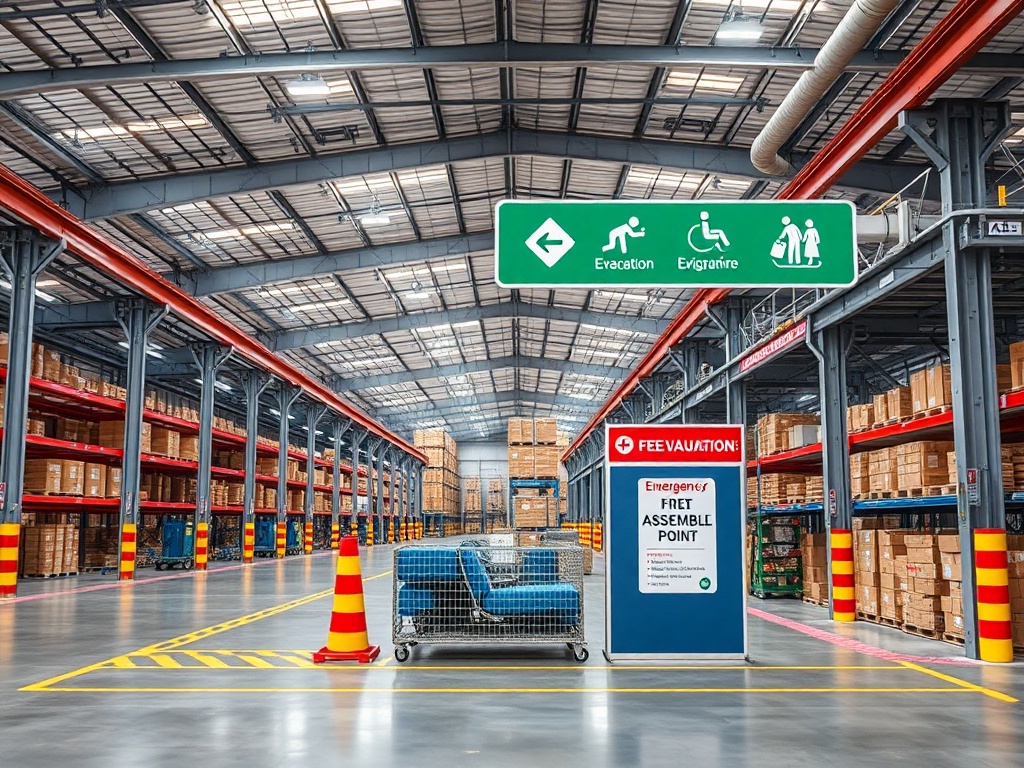
- Mark the assembly point with a permanent, weather-resistant sign that all staff recognise.
- Assign a muster warden or team leader to conduct a headcount against the shift roster immediately upon arrival. The muster warden should have a printed or digital shift roster accessible from the assembly point – not locked inside the evacuated building.
- Have a procedure for accounting for visitors, contractors, and delivery personnel who may not appear on the standard roster.
Fire Drills: Making Them Count
A fire drill that is conducted purely to satisfy a regulatory checkbox is worse than no drill at all – it creates a false confidence that people know what to do.
What a meaningful fire drill looks like
- Conduct at least one drill per year (MOM’s WSH (Incident Reporting) regulations and BizSAFE requirements treat this as a baseline – twice-yearly is better practice for high-occupancy operations).
- Vary the scenario: if your last drill assumed the fire started near the main entrance, this time simulate one starting in the racking area or cold storage zone.
- Time the evacuation. Record the time from alarm activation to full muster. If it exceeds your planned threshold, investigate why.
- Include contractors and temporary staff – they are often the least familiar with the layout.
- After every drill, conduct a debrief. Document findings and corrective actions. File the record – it demonstrates due diligence if SCDF or MOM inspects.
- Update your plan when layout changes: new racking installed, loading bay reconfigured, or a new cold storage zone commissioned all require plan review.
Fire Suppression Systems and Equipment
Passive systems (exit routes, fire doors, fire-rated walls) are only part of the picture. Active fire suppression equipment must be appropriate for your warehouse’s risk profile.
- Portable fire extinguishers: Type and quantity per the Fire Safety Act’s prescribed schedules. Water extinguishers for Class A (ordinary combustibles) fires; CO2 or dry powder for electrical fires; foam for flammable liquids. Inspections must be documented monthly.
- Hose reels: Required in most industrial buildings under the Fire Code. Hose reels must be unobstructed and the delivery rate must meet the stipulated pressure and flow requirements.
- Automatic fire suppression systems: For warehouses with high-piled storage, sprinkler systems are typically required above certain height thresholds. Cold storage zones require specialized low-temperature sprinkler heads. Consult a fire protection engineer if your storage configuration is non-standard.
- Fire alarm systems: Addressable fire alarm panels allow responders to identify the specific zone in alarm – critical in large warehouses where a single sensor activation may indicate the location of a fire’s origin.
What Singapore Warehouse Operators Commonly Get Wrong
From SCDF inspection records and WSH audit findings, several gaps appear repeatedly:
- Fire exit doors fitted with bolt chains from the outside. This is a direct Fire Safety Act violation. Emergency exits must open from inside without a key or special knowledge.
- Travel distance exceeding code limits due to changes in racking layout that were not referred back to the fire safety submission.
- Refuse to maintain common area fire systems in multi-tenant JTC premises because “the building management is responsible.” Tenant fit-out changes that affect fire-rated compartments, service duct penetrations, or emergency lighting require coordination with building management and may trigger a need for fresh fire safety submissions.
- Inadequate WAH (Working at Height) consideration during fire response. If your fire response plan includes any ladder use or roof access for isolation, this intersects with MOM’s WAH regulations and requires separate risk controls.
- Drill records not kept or not updated when staff turnover changes the roster.
Integrating Your Evacuation Plan With Broader WSH Management
A fire evacuation plan does not exist in isolation. It is most effective when integrated into your overall workplace safety management system. Under BizSAFE, this means the emergency response procedures are documented within your Risk Management Plan (RMP), which is reviewed annually or when significant changes occur.
Enterprise Singapore and the Singapore Standards Council also reference relevant standards such as SS 538 (Code of Practice for the Design and Maintenance of Buildings with regards to Fire Safety) and SS 575 (Fire Safety Management System) which provide structured frameworks for fire safety governance beyond the baseline Fire Safety Act requirements.
For warehouse operators in HDB industrial complexes, HDB’s own fire safety requirements for common areas apply in addition to the building-level requirements.
FAQ
Q: How often must a Singapore warehouse conduct a fire drill?
A: Under MOM’s WSH guidelines and BizSAFE requirements, at least one fire drill per year is the baseline for most operations. BizSAFE Level 3 and above typically requires documented emergency response procedures and verification. High-occupancy facilities (over 100 personnel per shift) should conduct drills at least twice yearly. All drills must be documented with findings and corrective actions.
Q: Who is responsible for fire safety in a multi-tenant JTC warehouse?
A: The building management (JTC Corporation or the managing agent) is responsible for common fire safety systems including shared stairways, fire alarm panels serving common areas, and the building’s fire certificate. Individual tenants are responsible for maintaining fire safety within their leased premises, including means of escape within their unit, and must not alter fire-rated elements without approval. Tenants should coordinate their evacuation plans with building management.
Q: What are the key differences between the Fire Safety Act requirements and MOM’s WSH requirements for warehouse fire preparedness?
A: The Fire Safety Act (administered by SCDF) focuses on the physical fire safety infrastructure: means of escape, fire suppression equipment, fire alarms, exit signage, and the building’s fire certificate. The WSH Act (administered by MOM) focuses on employer duty to protect workers, which includes ensuring emergency procedures exist, workers are trained, and drills are conducted. Both are mandatory. SCDF may inspect for Fire Safety Act compliance while MOM may inspect for WSH Act compliance – they are separate but complementary frameworks.
Q: What fire extinguishers are required in a typical Singapore warehouse?
A: The type and quantity of fire extinguishers is prescribed under the Fire Safety Act schedules based on the hazard class. A typical warehouse with mixed storage (Class A ordinary combustibles) and electrical equipment (Class E) requires water-type extinguishers for Class A risks and CO2 or dry powder for electrical risks. Extinguishers must be inspected monthly (documented) and serviced annually by a SCDF-approved contractor. Placement must ensure no travel distance exceeds 15-23 metres from any point to an extinguisher.
If your warehouse’s fire evacuation plan has not been reviewed in the past 12 months – or if your layout has changed, your headcount has shifted, or your last fire drill produced results you were not satisfied with – now is the time to act. SCDF inspections and MOM WSH audits do not announce themselves.
Contact a qualified fire safety consultant or engage your building management to coordinate a plan review. Budget for it the same way you budget for rack maintenance and forklift servicing. It is infrastructure.
And if you need support building out your broader WSH management system – including working towards BizSAFE certification – there are certified WSH advisors across Singapore who specialise in warehouse and logistics operations.
Related Articles:
Racking Collapse Prevention | Working at Height | Hazardous Goods Storage