Quick answer
Racking Collapse Risk in Warehouses: Causes, Prevention & Real Case Studies is important because racking collapses in Singapore warehouses are preventable with proper inspection, loading discipline, and maintenance. The practical goal is to improve safety, productivity, and buying confidence before selecting equipment or requesting a quotation.
Practical next steps
- Confirm the load, workspace, workflow, and safety requirements.
- Compare the product fit against daily operating conditions, not just catalogue specifications.
- Speak with YK Toh for sizing, compatibility, and quotation guidance.
Racking Collapse Risk in Singapore Warehouses: Causes, Prevention & Real Case Studies
Slot 3 — Racking Collapse Risk in Singapore Warehouses: Causes, Prevention & Real Case Studies
| Failure Cause | Severity | Prevention Measure |
|---|---|---|
| Overloaded racks beyond rated capacity | Critical | Install load labels; conduct regular weight audits |
| Damaged uprights/frames from fork truck impact | High | Install rack protectors; mandatory fork truck operator training |
| Incorrect anchor bolt installation | High | Use qualified installers; inspect anchor torque annually |
| Missing or damaged beam locking devices | High | Monthly beam hook inspection; replace damaged clips immediately |
| Uneven floor subsidence or settlement | Medium | Conduct floor level surveys annually; address drainage issues |
| Non-compliant rack modifications | Critical | Engage original manufacturer for any modifications |
Meta Description
Racking collapse in Singapore warehouses is preventable. Learn the top causes, MOM/WSH compliance requirements, BizSAFE steps, and rack inspection best practices to protect your facility.
Article Body
Why Racking Collapses Are a Silent Risk in Singapore Warehouses
Every year, Singapore’s Ministry of Manpower (MOM) investigates warehouse incidents where racking systems fail — sometimes catastrophically. In 2022 alone, MOM reported over 340 workplace injuries related to storage equipment across industrial facilities. Many of these incidents share a common thread: warning signs were present weeks or months before the collapse but were not acted upon.
A racking collapse is rarely a single-event failure. It is almost always the result of accumulated non-compliance — overloaded frames, damaged components, unapproved modifications, or improper anchor installation. In a city-state where industrial land is scarce and multi-tier racking installations are common, the consequences extend beyond equipment damage: businesses face MOM enforcement action, Work Stoppage Orders, BizSAFE demotion, and reputational harm with Enterprise Singapore-registered clients who demand documented safety compliance.
The Five Root Causes Behind Most Racking Collapses in Singapore
1. Exceeding Rated Load Capacity
Every pallet racking system is designed with a specific frame load rating — documented on the rack load signs posted at the end of each bay. Over time, as operational needs change, warehouse teams may add pallets without verifying that the additional weight stays within the rated capacity of the frames and beams. This is the single most common cause of progressive rack failure.
SS 573:2020 specifies that racking systems installed in Singapore must have documented load calculations and that capacity signage must be visible and legible. MOM inspectors will reference these signs during WSH Act compliance audits.
2. Forklift Impact Damage
Forklift strikes to rack frames are endemic in busy Singapore warehouses. A single significant impact can buckle a column, weaken a base plate, or dislodge a safety pin. Because the structural damage is often hidden inside the frame column, it may not be visible during a cursory walkthrough.
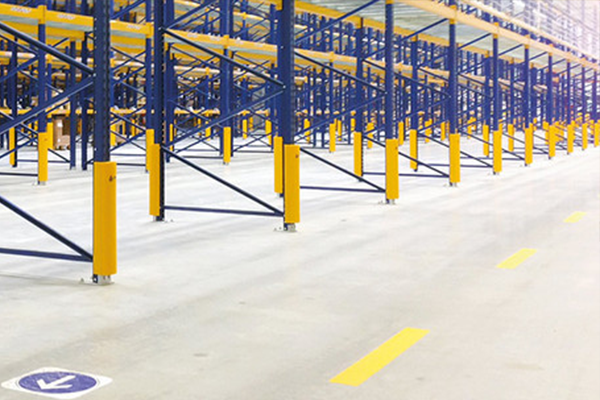
Column protectors and end-of-aisle protectors are mandatory in well-run facilities precisely because they reduce impact damage. Without them, each forklift traversal is a lottery.
3. Improper Installation and Anchor Failure
Racking systems must be anchored to the floor slab with the correct type and number of anchors, as specified by the racking manufacturer and the structural engineer. In Singapore, JTC industrial estates and many private industrial parks have floor slabs rated between 3–5 kN/m² — but older facilities may have degraded slab conditions that reduce effective anchor pull-out resistance.
Installation by non-certified personnel or modifications made without engineering sign-off are red flags. Any relocation or reconfiguration of racking should be overseen by a qualified racking engineer.
4. Missing or Damaged Safety Components
Beam locks, safety pins, wire mesh decking, and column guards are not optional extras — they are load-path components. When a beam lock disengages and the beam is not properly seated, the beam can脱钩 (disengage) under load, causing a progressive cascade failure.
Regular rack inspections (at least quarterly for busy warehouses, per WSHC guidance) must include a full component audit, not just a visual check.
5. No Documented Inspection Programme
MOM’s WSH Act places the responsibility for equipment safety squarely on the employer. Having a documented rack inspection log — with photos, defect descriptions, and remediation records — is not just good practice; it is a legal defensibility requirement. In the event of a collapse investigation, an inspection log demonstrates due diligence.
BizSAFE Level 3 and Level 4 companies are required to have risk assessment processes that cover equipment hazards. Racking falls squarely within this scope.
The Real-World Consequences: Case Studies
Case Study 1: Tampines Logistics Facility (2021)
A third-party logistics operator in Tampines experienced a partial rack collapse when a heavily overloaded beam disengaged during peak receiving hours. No injuries were reported, but the collapse blocked three pick aisles for 11 working days. MOM issued a Composition Offer of $9,500. The company’s BizSAFE certification was suspended pending corrective action review. Insurance excess claims exceeded $80,000. Post-incident investigation revealed that the facility had no formal rack inspection programme in place and the rack load signs had been painted over and were unreadable.
Case Study 2: Tiong Bahru Industrial Estate Storage Operator (2019)
A smaller operator in Tiong Bahru suffered a progressive frame failure when repeated forklift impacts weakened a corner column over several months. The collapse was caught during a routine MOM WSH inspection — the officer noted visible frame deformation — and a Work Stoppage Order was served immediately. The company incurred $22,000 in remediation costs and was required to commission an independent structural assessment from an Enterprise Singapore-recognised engineer before operations could resume.
Case Study 3: A太平 (Tuas) Food Distribution Centre (2023)
A racking collapse at a cold storage facility in Tuas resulted in minor injuries to two workers. SCDF attended as a precautionary measure. The root cause was identified as water ingress corroding rack anchors below the minimum required pull-out strength — a risk specific to cold storage environments where condensation and temperature differentials accelerate corrosion. MOM’s investigation led to updated guidance on anchor inspection protocols for racking in temperature-controlled warehouses.
Prevention Framework — What Singapore Warehouse Operators Must Do
Implement a Quarterly Rack Inspection Programme
Engage a qualified racking inspector or an engineer registered with a professional body to conduct formal inspections. Use a standardised checklist that covers: frame verticality (plumb tolerance per SS 573), anchor condition, beam engagement and locking, load sign visibility, and component damage.
Maintain inspection records for a minimum of three years. Digital photo documentation with timestamps provides the strongest evidence of due diligence.
Install Physical Protection
Column protectors, rack guards, and end-of-aisle barriers are proven to reduce forklift impact damage by up to 70% in high-traffic aisles. Budget for these as operational necessities, not optional safety extras.
Conduct Monthly Internal Walldowns
Between formal inspections, assign a trained supervisor to walk every racking bay monthly. Train them to recognise the seven warning signs of rack stress: bent columns, sagging beams, missing safety pins, painted-over load signs, unsecured base plates, loose anchors, and any evidence of impact damage.
Obtain or Upgrade Your BizSAFE Certification
BizSAFE Level 3 (or higher) is increasingly required by Enterprise Singapore-registered clients and multinational principals as a precondition for commercial contracts. Achieving BizSAFE Level 3 requires a WSH Management System audit by a MOM-approved certification body. This process compels you to formally document hazard identification — including racking hazards — which creates the structural foundation for a rack inspection programme.
Verify Compliance with SS 573:2020
SS 573:2020 is the Singapore Standard governing the design, installation, and testing of industrial racking. It sets requirements for frame load ratings, beam deflection limits, earthquake-resistant design (relevant for some JTC sites), and inspection frequency. If your racking was installed before 2020, have it assessed against the current standard — it may be non-compliant by default.
The Cost of Doing Nothing
A single racking collapse can result in:
- MOM Composition Fine: $5,000–$25,000 (first-time offences)
- Work Stoppage Order: 3–14 days of lost revenue
- Business Interruption Insurance excess: typically $10,000–$50,000
- Client contract penalties or loss of preferred vendor status
- Potential criminal liability under the WSH Act for senior management
The cost of a proactive inspection and protection programme for a typical Singapore SME warehouse (20–50 racking bays) is $3,000–$8,000 per year. The cost of a collapse is 5–20 times higher — before accounting for reputational damage.
FAQ Section
Q: How often should pallet racking be inspected in Singapore?
A: Per WSHC guidance and BizSAFE requirements, a formal professional inspection should be conducted at least annually. High-traffic warehouses (over 50 pallet moves per day per aisle) should inspect quarterly. Monthly internal walkdowns by a trained supervisor are strongly recommended. MOM may request inspection records during any WSH Act compliance audit.
Q: What is the Singapore standard for racking system design?
A: SS 573:2020 is the current Singapore Standard for the design of industrial racking systems. It covers structural requirements, load ratings, earthquake provisions, and inspection criteria. All new racking installations in Singapore should comply with this standard. Existing installations predating 2020 should be assessed against it.
Q: Can my warehouse continue operating after a MOM rack inspection?
A: If MOM identifies an imminent risk, they will issue a Stop Work Order under the WSH Act. Operations cannot resume until a qualified engineer confirms remediation. A Composition Offer may be issued for less severe non-compliance — this resolves the matter without a court hearing but requires documented corrective action.
Q: Does BizSAFE Level 3 cover racking safety specifically?
A: BizSAFE Level 3 requires a risk assessment of all significant workplace hazards, of which racking is one. The risk assessment must identify control measures — including inspection protocols, load signage, and physical protection — that are then documented in your WSH Management System. Maintaining BizSAFE certification requires demonstrating ongoing implementation of these controls.
Q: What causes racking anchors to fail in Singapore warehouses?
A: Anchor failure is typically caused by corrosion (especially in cold storage or high-humidity environments), incorrect anchor type or spacing during installation, floor slab degradation over time, or vibration from forklift traffic loosening the anchor. SS 573:2020 specifies anchor pull-out requirements. Annual anchor inspections should be part of your formal rack inspection programme.
- — Pallet Racking Inspection Singapore article
- — SS 573 Compliance Guide article
- — BizSAFE Implementation for Warehouse Operators article
If your Singapore warehouse operates more than 20 racking bays and you cannot produce documented rack inspection records for the past 12 months, your facility is likely non-compliant with MOM WSH Act requirements — and exposed. Contact us at enquiry@yktoh.com or call +65 6542 3232 during office hours for a no-obligation consultation. We can help you build the documentation framework needed for both compliance and client pre-qualification.
Related Articles:
Racking Inspection | Upright Protection | Fire Evacuation Planning | Working at Height