Quick answer
Hazardous Goods Storage in Warehouses: A Practical Guide to DG Storage Compliance is important because storing dangerous goods in Singapore warehouses requires compliance with SCDF and NEA regulations. The practical goal is to improve safety, productivity, and buying confidence before selecting equipment or requesting a quotation.
Practical next steps
- Confirm the load, workspace, workflow, and safety requirements.
- Compare the product fit against daily operating conditions, not just catalogue specifications.
- Speak with YK Toh for sizing, compatibility, and quotation guidance.
Hazardous Goods Storage in Singapore Warehouses: A Practical Guide to DG Storage Compliance
Introduction: Why Hazardous Goods Compliance Is Non-Negotiable in Singapore
Singapore’s warehouse operators face a compressed regulatory environment. In the space of a single industrial building—often managed by JTC Corporation or a private landlord—your operations may need to satisfy MOM’s Workplace Safety and Health Act, SCDF’s fire code, Enterprise Singapore’s guidelines on dangerous goods, and NEA’s environmental health requirements. Get any one of these wrong and the consequences are immediate: operational shutdown, fines up to S$5,000 per offence under the WSH Act, or worse—Loss of life.
This guide covers the practical essentials of hazardous goods (DG) storage compliance for Singapore warehouse operators. It is written for operations managers, warehouse supervisors, and business owners who store Class 3 flammable liquids, Class 4 flammable solids, Class 5 oxidisers, Class 6 toxic substances, Class 8 corrosives, or pressurised gas cylinders on their premises. If that sounds like your facility, read on.
Understanding Singapore’s DG Classification System
Singapore adopts the United Nations Recommendations on the Transport of Dangerous Goods (UN Model Regulations) through the Civil Defence (CD) Hazmat regulations. The classification system runs from Class 1 (explosives) through Class 9 (miscellaneous). Most warehouse operators in Singapore deal with Classes 3, 4, 5, 6, 8, and 9.
The nine DG classes relevant to Singapore warehouses
- Class 3 — Flammable liquids (petrol, acetone, paints, solvents, adhesives)
- Class 4 — Flammable solids (sulphur, aluminium powder, magnesium)
- Class 5 — Oxidising substances and organic peroxides (hydrogen peroxide >8%, potassium permanganate)
- Class 6 — Toxic and infectious substances (pesticides, certain solvents)
- Class 7 — Radioactive materials (requires NEA and MOH licensing separately)
- Class 8 — Corrosive substances (sulphuric acid, hydrochloric acid, sodium hydroxide solutions)
- Class 9 — Miscellaneous dangerous goods (dry ice, lithium batteries, asbestos)
Knowing your classes matters because storage requirements—specifically fire separation distances, ventilation rates, spill containment volumes, and闵 shelving types—differ significantly between them.
The Regulatory Framework: Which Authority Controls What
This is where most operators get confused. Three agencies have overlapping jurisdiction:
1. MOM — Workplace Safety and Health (WSH) Act
Under the WSH Act (Cap. 354A), employers and occupiers have a duty to control hazardous substances in the workplace. MOM’s Workplace Safety and Health (WSH) (hazardous Substances) Regulations require:
- A Hazardous Substance Permit (HSP) from MOM before storing certain quantities of scheduled hazardous substances
- A Risk Assessment (RA) documented for all DG storage areas
- Implementation of Control Measures documented in a Safety Data Sheet (SDS) hierarchy
- Annual Medical surveillance for workers handling scheduled substances above threshold quantities
- Emergency response procedures posted on-site and drill-tested
Threshold quantities that trigger the HSP requirement are defined in MOM’s schedule. For Class 3 flammable liquids, the general threshold is 200 litres of scheduled solvents. For Class 8 corrosives, it can be as low as 50 litres depending on concentration.
BizSAFE certification (Level 3 or Level 4) is effectively mandatory for operators seeking to store DG. MOM and its appointed contractors will expect BizSAFE certification during inspections.
2. SCDF — Fire Code for DG Stores
The SCDF Fire Code (Singapore Civil Defence Force Act, Cap. 295) governs the physical storage requirements for DG. Key provisions include:
- Fire separation between DG stores and adjacent areas, measured in metres (typically 3m for Packages Group II, 6m for Packages Group I)
- Fire-rated construction for DG store walls and doors (typically 4-hour rating for Class 3 stores over certain quantities)
- Ventilation rates — minimum 6 air changes per hour for enclosed DG stores, or mechanical exhaust at 1 m/s face velocity
- Spill containment — designated areas with raised thresholds (minimum 150mm bund height) capable of retaining 110% of the largest container’s volume
- Electrical equipment in DG zones must be rated for the hazardous area classification (Zone 0, 1, or 2)
- No smoking and no hot work signage conforming to ISO 7010 must be posted at all entry points
- Firefighting equipment — CO2 or foam extinguishers appropriate to the DG class, inspected monthly
SCDF mandates that any DG store with a floor area exceeding 25 m² or storing quantities above threshold must be individually approved by SCDF before use. Plans must be submitted through the SCDF’s Fire Safety Certificate application process.
3. Enterprise Singapore — DG Storage Guidelines
Enterprise Singapore (formerly SPRING Singapore) publishes guidelines aligned with the UN Model Regulations and Singapore Standards. While not law themselves, these guidelines are incorporated by reference in MOM and SCDF requirements. Key standards include:
- SS 573 — Code of Practice for the Storage of Flammable Liquids (adopted by SCDF)
- SS 516 — Fire Protection Installation standard (for suppression systems in DG zones)
- CP 88 — Emergency response procedures for chemical incidents
Enterprise Singapore also administers the Registered Hazardous Waste Collectors framework. If your DG storage generates waste (expired chemicals, contaminated absorbents), you must use a registered collector.
Practical Storage Requirements: What Your Facility Actually Needs
Beyond the regulatory framework, here is what a compliant DG store looks like on the ground:
Physical Infrastructure
- Dedicated room or compound — DG goods must not be co-mingled with general stock. JTC and HDB industrial tenants typically have a designated zone written into their tenancy agreement.
- Bunding — A 150mm-high bund with chemical-resistant liner surrounding the storage area. Capacity must equal 110% of the largest single container, or 25% of the total stored volume—whichever is greater.
- Flooring — Impermeable, chemical-resistant floor (epoxy coating or similar). Cracks or joints must be sealed.
- Ventilation — Mechanical exhaust with ATEX-rated fans, minimum 6 air changes per hour. Natural ventilation alone is insufficient for enclosed DG stores above 50 m².
- Lighting — ATEX-rated light fittings. Standard fluorescent tubes generate enough heat to be a ignition risk in Zones 0 and 1.
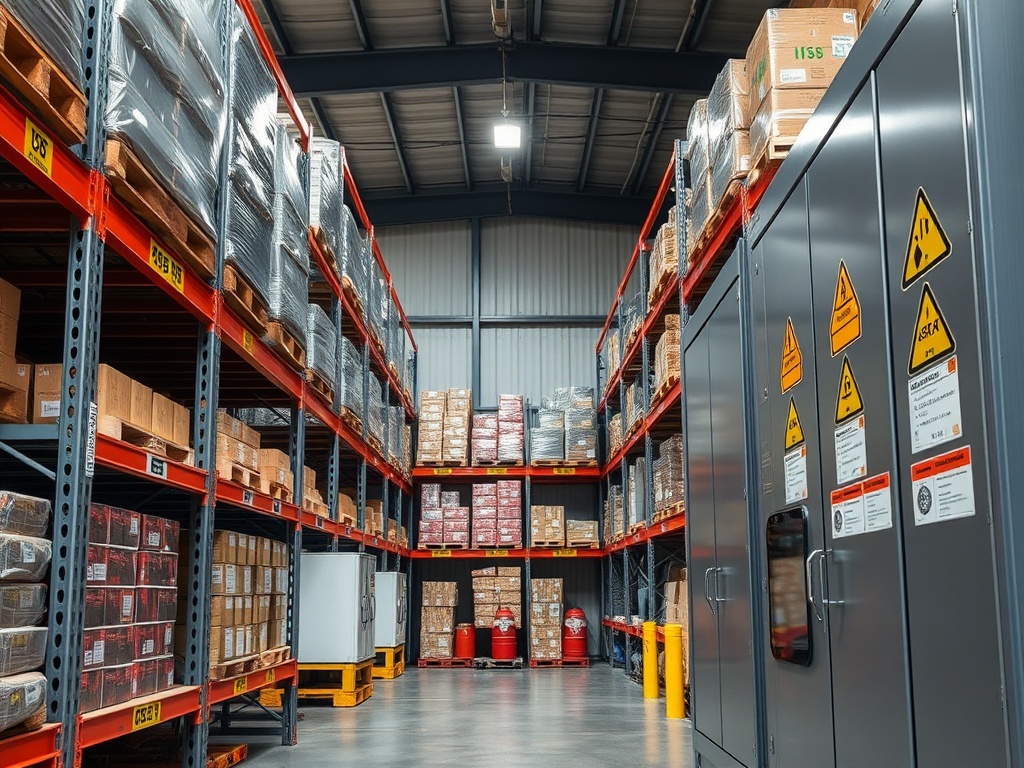
- Racking in DG stores — Use corrosion-resistant racking (stainless steel or plastic). Wooden racking is prohibited for Class 3 and Class 4 goods. Rack load signs must indicate maximum safe loads.
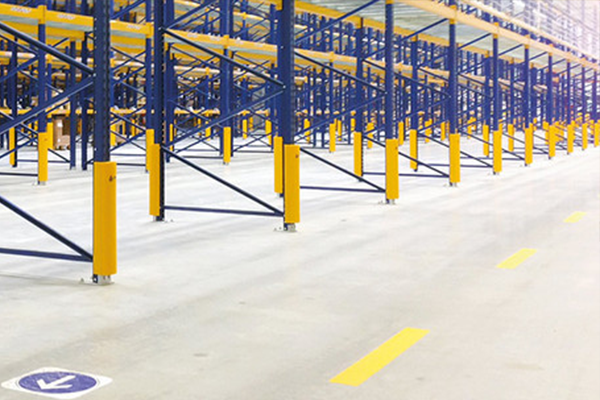
- Column protectors and end-of-aisle guards — Required to prevent forklift impact damage to racking, which is especially dangerous in DG zones.
Operational Controls
- SDS management — Every chemical product on-site must have a current Safety Data Sheet (SDS), typically valid for 3 years. Outdated SDSes are a common inspection failure point.
- HAZCHEM signage — ISO 7010 warning signs for each hazard class must be posted at the DG store entrance. SCDF requires HAZCHEM board display (UN number, hazard class, emergency contact).
- Segregation matrix — Chemicals that react dangerously with each other (e.g., Class 3 flammable liquids near Class 5 oxidisers) must be physically separated by a minimum 3m fire-rated barrier.
- Permit-to-work system — Hot work, confined space entry, and maintenance involving DG store infrastructure require a documented PTW.
- Spill kit — Minimum 20-litre spill kit with chemical absorbent granules, sealed disposal bags, and PPE (nitrile gloves, goggles, disposable coveralls) positioned within 5m of the DG store.
- Medical first aid — Eye wash station (flushing fluid: clean water or saline) required within 10 seconds’ travel time for Class 6 and Class 8 storage. Inspected weekly.
Training and Documentation
- All workers handling DG must have WSH-approved Hazardous Substances training (BizSAFE Level 3 covers this)
- Incident log — All spills, near-misses, and regulatory inspections must be recorded in a register
- Emergency Response Plan (ERP) — Site-specific, posted at DG store entry, covering fire, spill, and medical response. Must be drill-tested annually.
- Near-miss culture — Under MOM’s WSH framework, near-miss reporting is mandatory and must be followed up with corrective actions logged in the safety register
Common Compliance Failures in Singapore DG Warehouses
Based on MOM and SCDF enforcement data from 2020–2025, the most frequent DG storage violations found in Singapore warehouses include:
- Missing or expired Hazardous Substance Permits — Operating without a valid MOM HSP or failing to renew on time
- Inadequate spill bunding — Bunding capacity below the 110% statutory minimum, or bund walls with cracks/leak points
- Co-mingling DG classes — Storing incompatible DG classes within the same enclosed space without fire-rated separation
- Undated or incomplete SDS — Safety Data Sheets not reviewed within 3 years or lacking UN classification information
- ATEX non-compliant equipment — Standard electrical equipment (extension cords, fans, phones) used within Zone 1 DG areas
- Missing rack load signs — Storage racking without clearly posted maximum load capacity signs, as required under MOM WSH guidelines
- No spill kit or spill kit depleted — Absorbent materials used for general cleaning and not replenished
- Emergency eyewash not operational — Eye wash stations found dry or not inspected weekly
Any one of these is an immediate non-conformance under the WSH Act. MOM inspectors can issue a Stop-Work Order on the DG storage area on the spot.
Penalties and Enforcement: What You Risk
| Offence | Maximum Penalty |
|---|---|
| WSH Act — Failure to control hazardous substances | S$5,000 per offence (first conviction); S$10,000 per offence (subsequent) |
| WSH Act — Causing death or grievous hurt | Up to 2 years imprisonment and/or S$100,000 fine |
| SCDF Fire Code — Operating unapproved DG store | S$10,000 and S$2,000 daily continuing offence |
| MOM HSP — Operating without permit | S$10,000 and/or 12 months imprisonment |
| NEA Environmental Public Health Act — Improper toxic waste disposal | Up to S$40,000 and 12 months imprisonment |
Beyond fines, a BizSAFE Level 3 or 4 certification can be suspended following a serious DG incident, effectively blocking your ability to bid on government and large corporate contracts.
Getting Your DG Store Audit-Ready in 5 Steps
- Map your inventory to DG classes — List every chemical on-site with its UN number, class, quantity, and SDS reference. Identify which require MOM HSPs.
- Engage a WSH-approved consultant for a Gap Assessment — A one-day audit against MOM, SCDF, and Enterprise Singapore requirements typically costs S$800–S$2,500. Far cheaper than a Stop-Work Order.
- Upgrade physical infrastructure — Fix bunding, replace non-ATEX electrical equipment, install or replace racking with chemical-resistant units, post ISO 7010 signage.
- Submit SCDF Fire Safety Certificate application — If your DG store exceeds 25 m², formal SCDF approval is required. Lead time is typically 4–8 weeks.
- Achieve or renew BizSAFE certification — BizSAFE Level 3 or 4 is effectively mandatory. Ensure all staff handling DG have completed the WSH hazardous substances module.
Frequently Asked Questions (FAQ)
Do I need a Hazardous Substance Permit from MOM if I store only small quantities of flammable liquids in my Singapore warehouse?
Yes, if the quantity stored exceeds MOM’s threshold for scheduled substances. For Class 3 flammable liquids commonly used in manufacturing (acetone, toluene, xylene), the threshold is generally 200 litres for scheduled solvents. Even quantities below the HSP threshold require a documented Risk Assessment and control measures under the WSH Act. Consult MOM’s website or a WSH-approved consultant to confirm whether your specific substances and quantities trigger permit requirements.
Can I store Class 3 flammable liquids and Class 8 corrosives in the same DG store?
No, not without a physical fire-rated separation barrier rated to at least 4 hours. Class 3 flammable liquids and Class 5 oxidisers are particularly dangerous in combination—mixing can cause spontaneous ignition. Under SCDF’s fire code and SS 573, incompatible DG classes must be segregated by a minimum 3m open gap or a fire-rated barrier. A qualified hazmat consultant should prepare a DG segregation matrix for your facility.
What is the minimum fire rating for a Class 3 flammable liquids store in Singapore?
Under SCDF’s Fire Code and SS 573, enclosed Class 3 DG stores storing above threshold quantities require a 4-hour fire-rated construction for walls and ceiling, with 2-hour fire-rated doors. The specific requirement depends on total quantity stored and whether the store is standalone or attached to other occupancies. Quantities below the SCDF threshold may only require standard construction with enhanced ventilation—but this must be confirmed through a formal SCDF submission.
How often must spill kits and eye wash stations be inspected in a Singapore DG warehouse?
Eye wash stations must be activated and flushed weekly, with the inspection recorded in a log. Spill kits must be checked monthly for completeness and all absorbent materials replenished after any use. MOM inspectors frequently ask to see these logs during WSH audits. The spill kit location must be within 5 metres of the DG store entrance and clearly marked with ISO 7010 signage.
Who approves DG store plans in Singapore and what is the process?
SCDF is the approving authority for the physical DG store. An application must be submitted through SCDF’s Fire Safety Certificate (FSC) application portal for DG stores exceeding 25 m² in floor area. MOM HSP applications are submitted separately through MOM’s GoBusiness portal. If your facility is in a JTC or HDB building, your landlord’s written consent and endorsement of the DG store layout is also required before SCDF will process the application.
Conclusion: DG Compliance Is Operational Infrastructure, Not Just Paperwork
Hazardous goods storage compliance in Singapore is demanding—but it is also entirely achievable with a systematic approach. The operators who get it right treat DG compliance as part of their core operational infrastructure, not as a box-ticking exercise. They maintain current permits, conduct regular inspections, train their people properly, and keep their physical infrastructure to standard.
The cost of getting compliant—typically S$5,000–S$25,000 for a full gap assessment, infrastructure upgrades, and certification—is trivial compared to the cost of a Stop-Work Order, a suspended BizSAFE certification, or worse, a serious incident.
If your warehouse stores any class of dangerous goods and you are not confident your current operations meet MOM, SCDF, and Enterprise Singapore requirements, engage a WSH-approved consultant for a no-obligation DG compliance gap assessment. The investment is typically recovered in the first avoided enforcement action. LINK: loading-bay-safety-singapore] —
Related Articles:
Cold Storage Racking | Fire Evacuation Planning | Racking Collapse Prevention