Quick answer
Health And Safety Executive Endorses The Use Of Electric Tugs For Cost Saving In Hospitals is important because the benefits of electric tugs have been reinforced by the Health and Safety Executive (HSE) which has suggested that the use of them in hospitals provides an ideal solution for por The practical goal is to improve safety, productivity, and buying confidence before selecting equipment or requesting a quotation.
Practical next steps
- Confirm the load, workspace, workflow, and safety requirements.
- Compare the product fit against daily operating conditions, not just catalogue specifications.
- Speak with YK Toh for sizing, compatibility, and quotation guidance.
How Electric Tugs Are Improving Efficiency and Safety in Hospitals
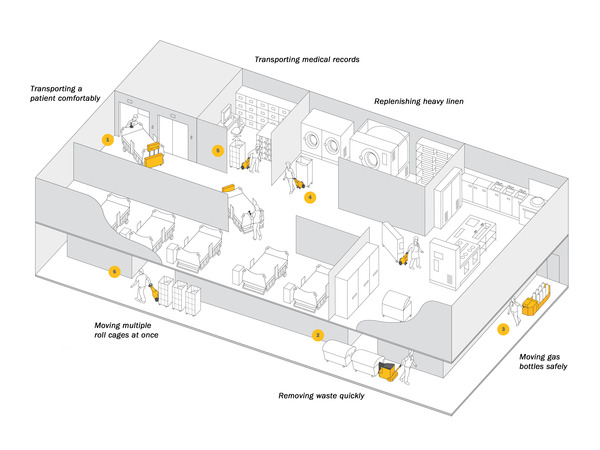
Hospital porters are among the most essential yet often overlooked members of a healthcare team. They keep operations moving — transporting medical records, catering trolleys, laundry, waste, patient beds, and gas cylinders across wards and corridors every single day. But when manual handling demands become too heavy, it doesn’t just affect the porters — it directly impacts the quality of patient support and the overall efficiency of the hospital. Over time, the physical strain of these repetitive tasks can lead to fatigue, injury, and reduced capacity, all of which have a knock-on effect on how well a facility functions.
The Health and Safety Executive (HSE) has recognised this challenge and voiced its support for electric tug solutions as a practical answer. The key advantage is simple: electric tugs allow portering staff to move more than one load at a time, reducing the number of trips required and freeing up time for more critical tasks. For hospitals already stretched on resources, that efficiency gain matters enormously — and the HSE’s endorsement carries significant weight in pushing healthcare facilities to explore better alternatives to manual handling.
Electric tugs aren’t new to industry. They’ve already made a significant impact in sectors like retail, aerospace, and construction, where improvements in both safety and operational efficiency have been well documented. Hospitals are now seeing those same benefits translate into a healthcare setting, where the stakes are arguably even higher. The controlled, predictable movement of loads through busy corridors and wards reduces the risk of accidents and injuries for both staff and patients.
MasterMover, a leading provider of electric tug solutions, has been at the forefront of this transition. Sales Director Hugh Freer explains that by adapting technology originally developed for industrial environments, the company has been able to generate substantial cost savings for hospital trusts while improving safety within wards and corridors. Their equipment is already in use across more than 130 hospitals in the UK — a testament to how widely the need has been recognised and how well the technology has been received in real-world healthcare environments.
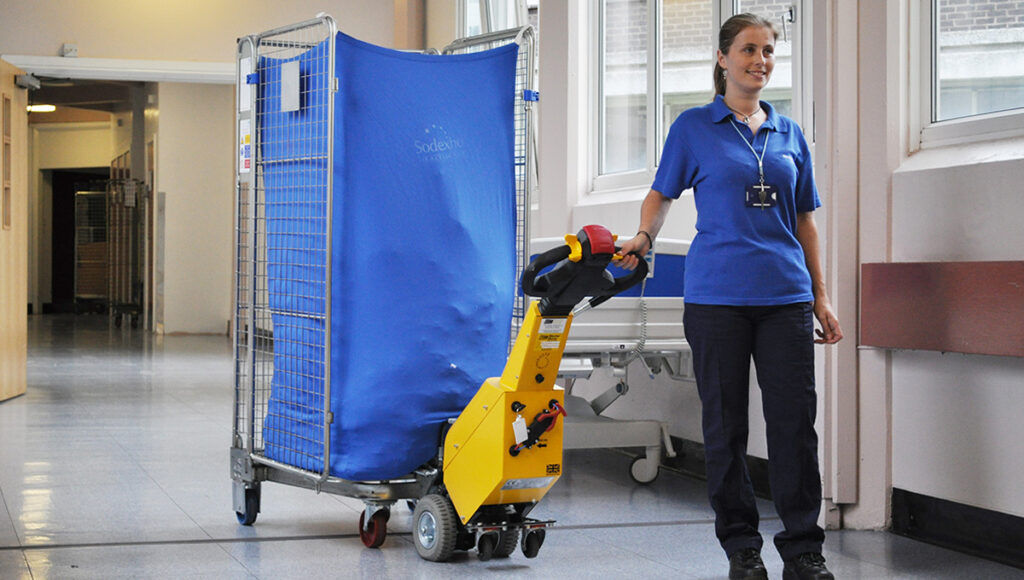
Among their most practical offerings for hospitals is the BedMover, a tug designed specifically for transporting patient beds. It operates wirelessly, moves beds quickly, smoothly, and quietly, and is built to be handled by a single operative — making what was once a two-person task entirely manageable for one. Both the BedMover and SmartMover models are built for high-frequency use, with the flexibility to handle tight corners, sharp turns, slopes, uneven ground, and even carpeted areas, meaning they can be deployed virtually anywhere within a hospital facility without limitation.
For waste and supply management, electric tugs can link multiple cages or waste bins together, moving them all in a single trip. This alone significantly cuts down on time spent on repetitive transport runs. MasterMover also offers a Gas Bottle Mover capable of transporting 16 to 20 cylinders at once in a precise and controlled manner — making cylinder replenishment rounds far safer and more efficient than manual handling allows.
The operational case for electric tugs goes beyond convenience. Research has identified portering delays as a significant contributing factor to missed waiting time targets and extended patient stays — both of which are critical performance measures for NHS trusts. When portering runs smoothly, the entire patient journey becomes more efficient, and service delivery performance improves across the board. Electric tugs directly support that outcome.
Hugh Freer believes the benefits of this technology have yet to be fully realised across the NHS, and that a broader review of portering resources could uncover significant gains hospital-wide. MasterMover supports this not just through equipment, but through training, servicing, and ongoing guidance to help trusts develop material handling practices that deliver lasting results.
For hospitals looking to reduce manual handling risks, improve staff wellbeing, and meet service delivery targets more consistently, electric tugs offer a straightforward, proven solution — one that’s already making a measurable difference across the country.