Rack Protection Vs Bollards Vs Guard Rails Vs Loading Bay Protection: What Should You Install First?
Start with the impact point, not the product name. Use rack protection when the damage risk is at rack uprights and rack ends. Use bollards when a fixed point such as a column, doorway edge, or machine corner needs localised impact protection. Use guard rails when the real problem is traffic separation along a route. Use loading bay protection when the damage risk sits at vehicle approach, wheel guidance, dock approach, or dispatch impact zones.
Use the site condition, load interface, operator effort and working route to decide the equipment or protection family before narrowing the model.
Quick answer
The wrong buying question is Which protection product is best? The better question is Where does the impact happen, and what needs to stay accessible after protection is installed?
Why these routes get mixed up
Many warehouse and industrial sites know they have impact damage, but the language gets blurred:
- rack damage
- truck strikes
- door-frame knocks
- loading bay scrapes
- pedestrian conflict
- repeated trolley and pallet-truck contact
These are not all the same problem. If the impact point is different, the protection route should also be different.
What each protection type is for
Rack protection
Rack protection is for protecting racking uprights, end frames, and rack-impact zones. It is the better route when forklifts, reach trucks, or pallet trucks repeatedly threaten the rack structure itself.
Bollards
Bollards are for point protection. They usually fit where a column, door edge, machine corner, utility point, or structural feature needs a compact protective barrier.
Guard rails
Guard rails are for route separation. They are more relevant when the problem is ongoing traffic movement between vehicles, carts, equipment, and pedestrians along a lane rather than repeated impact at one isolated point.
Loading bay protection
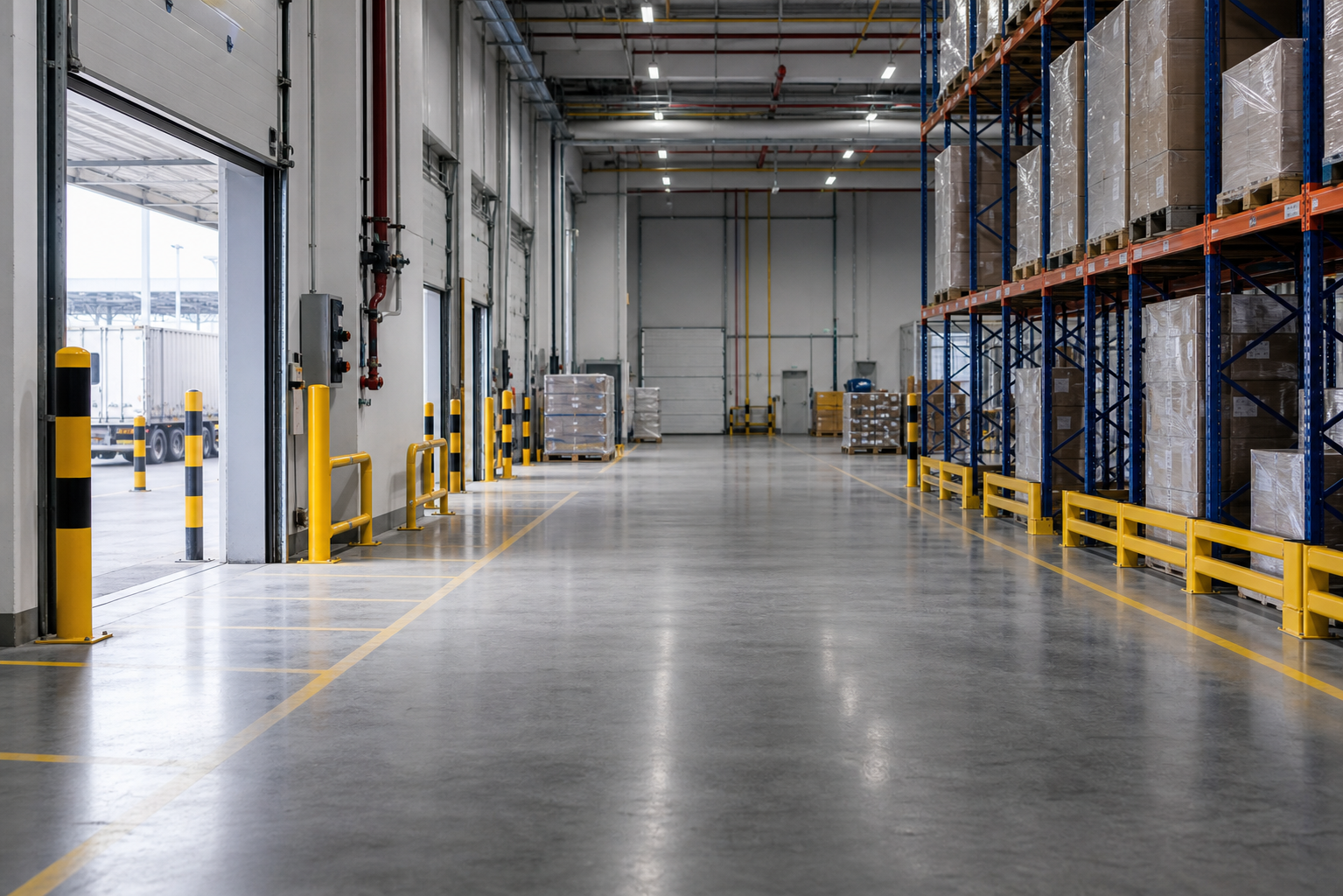
Loading bay protection is for dispatch and approach zones where vehicle guidance, edge contact, or dock-related manoeuvring causes repeated damage. This route is different from rack protection because the impact pattern is different.
Comparison table
| Protection route | Main problem solved | Best fit area | What to review first |
|---|---|---|---|
| Rack protection | Upright and rack-end impact | Storage aisles and racking zones | traffic direction, aisle width, vehicle type |
| Bollards | Point impact at fixed assets | columns, corners, doors, machine edges | exact strike point and clearance |
| Guard rails | Traffic separation | lanes, walkways, route boundaries | flow direction, vehicle path, pedestrian route |
| Loading bay protection | Dock and approach impact | dispatch and loading areas | vehicle approach, wheel path, turning and guidance |
Choose by impact point
1. Rack uprights and rack ends
If the repeated contact happens at the racking structure, start with rack protection. This is the most direct Stage 1 protection route for pallet storage environments.
2. Columns, corners, door edges, and isolated fixed assets
If the issue is localised and structural, bollards or point-protection formats are usually more relevant than a long traffic barrier.
3. Shared vehicle and pedestrian lanes
If the issue is not one impact point but a repeated traffic conflict, guard rails or route barriers become the more useful first route.
4. Dispatch, dock, and bay approach zones
If damage happens while trucks, wheeled loads, or internal vehicles approach the dispatch area, loading bay protection should be reviewed separately from rack and aisle protection.
Common site situations
Warehouse aisle damage
If uprights keep taking contact near the aisle entry, rack protection should usually be reviewed before broader traffic products.
Doorway and column damage
If the repeated strikes happen at structural points, bollards or local protection may be the cleaner answer.
Busy internal route with people and equipment crossing
If the concern is route separation rather than one exact strike point, guard rails or barrier systems are the better starting route.
Dispatch approach and truck manoeuvring
If the repeated damage is around approach lines, dock guidance, or edge-control areas, loading bay protection deserves its own review.
Do not block the working route by mistake
Protection should reduce damage without blocking the operator path, work route, cleaning route, or equipment access that still needs to function. This matters especially in packing, production-support, and food-related environments where the protected area must remain usable after installation.
What to check before choosing
Before asking for a recommendation, confirm:
- where the impact actually happens
- what type of vehicle or load causes the damage
- frequency of contact
- route width
- turning space
- whether the zone includes pedestrians
- whether the area is a storage aisle, production route, cold route, or loading bay
- whether access must stay open for cleaning, picking, or operator use
Photos of the exact strike point are often more useful than a broad site description.
What to send Y K TOH
Send:
- photos of the damage point
- route width
- vehicle type
- where the operator needs to keep access open
- whether the issue is at the rack, wall, column, door, lane, or loading bay
- whether the area is chilled, wet, or otherwise environment-sensitive
That makes it easier to route the enquiry into the right protection family.
FAQ
Are bollards and guard rails the same thing?
No. Bollards are usually point protection. Guard rails are more useful when the route needs separation across a longer line.
Is rack protection enough for every warehouse safety problem?
No. Rack protection helps when the rack structure is the impact point. It does not automatically solve dispatch guidance, walkway separation, or loading bay contact.
Should loading bay protection be treated as a separate route?
Yes. Dispatch and approach zones often have a different impact pattern from storage aisles, so they should be reviewed separately.
Can one product type protect every area?
Usually no. Many sites need a combination of rack protection, point protection, route barriers, and loading bay measures depending on where the real contact happens.
Next step
If your Singapore warehouse or industrial site is seeing repeated impact damage, start by identifying the impact point and the route that must remain usable. Y K TOH can help narrow whether the better first route is rack protection, bollards, guard rails, or loading bay protection before discussing the product family.
Related routes:
- MPM Flexible Protections Singapore
- Storage Racking Systems Singapore
- Warehouse Equipment & Material Handling
Related Y K TOH routes
Ask Y K TOH to review the site route
Send photos, route details, load information and the current handling or protection issue so the recommendation starts from the site problem, not only the catalogue.