

Sumitomo QuaPro-R Electric Reach Forklift
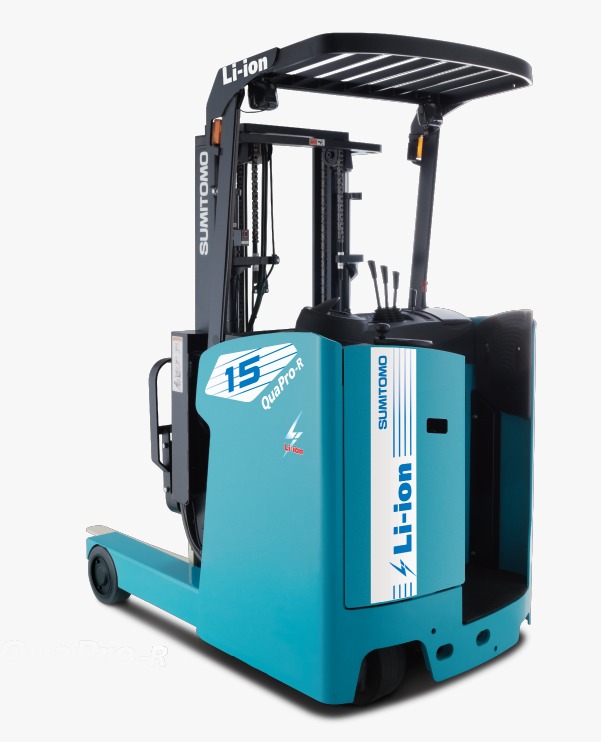
Boost warehouse productivity with the Sumitomo QuaPro-R Electric Reach Forklift — a lithium-ion reach truck designed for narrow aisle operation, long runtime, lower energy use, and safer material handling in Singapore warehouses.
Quick Selection Notes
- Use this when: You need Sumitomo QuaPro-R Electric Reach Forklift to handle pallet movement where lift height, aisle width and load control matter.
- User perspective: The operator needs enough capacity, visibility and aisle clearance to place loads without fighting the layout.
- Check before ordering: Confirm load weight, lift height, pallet size, aisle width, floor condition and charging or battery setup.
- Site fit: Match it to the route, floor surface, turning space, traffic flow and daily movement volume.
- Ask Y K Toh to confirm: Share load details, route photos, dimensions, floor condition and daily usage so the recommendation is sized around the real job.
Sumitomo QuaPro-R Electric Reach Forklift
The Sumitomo QuaPro-R Electric Reach Forklift is built for modern warehouse operations that need higher productivity, tighter aisle performance, reliable battery runtime, and lower operating cost.
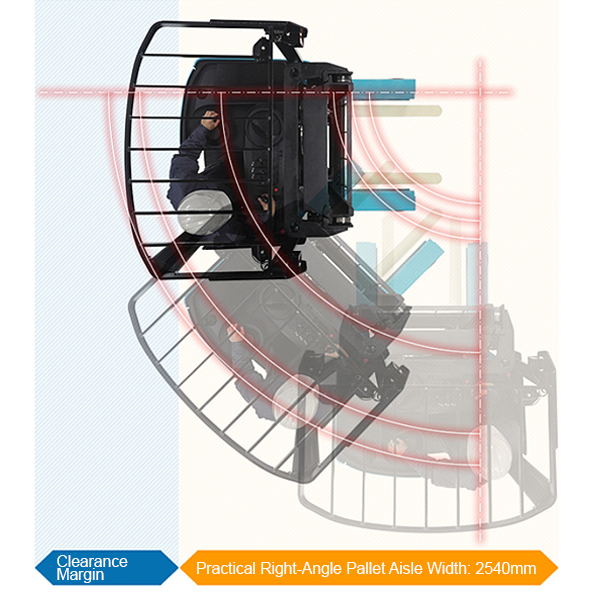
With a compact 2,540mm stacking aisle width, the QuaPro-R helps warehouse teams make better use of storage space while maintaining smooth pallet handling. It is suitable for Singapore facilities where warehouse rental cost, aisle planning, manpower efficiency, and operational uptime matter.
Powered by lithium-ion battery technology and supported by a high-frequency intelligent charger, the QuaPro-R can operate for up to 9.8 hours on a single charge. Its energy-efficient design helps reduce power consumption by up to 24%, while productivity can improve by up to 33% depending on site conditions and workflow.
Why the QuaPro-R Stands Out
- 2,540 mm practical right-angle stacking aisle width for tighter warehouse layouts.
- +33% productivity gain to support faster material handling workflows.
- -24% power consumption to support operating cost and sustainability goals.
- 9.8 hours single-charge operating time for longer shift coverage.
- 356 kg CO₂ reduction per year to support cleaner warehouse operations.
Product Visuals & Key Benefit Icons
The QuaPro-R is supported by clear visual selling points for customers comparing warehouse reach truck options.

Key Benefits at a Glance
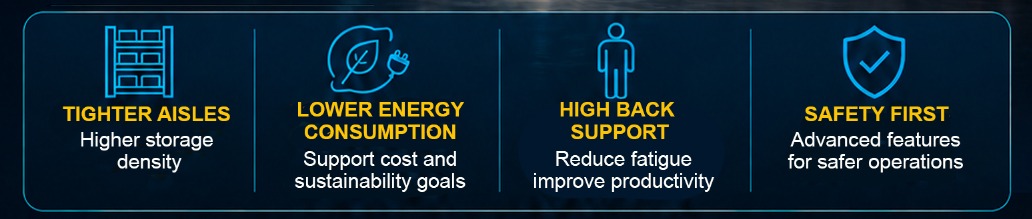
- Tighter aisles: Higher storage density for warehouses that need to maximise racking capacity.
- Lower energy consumption: Supports operating cost control and sustainability goals.
- High back support: Helps reduce operator fatigue and improve productivity during longer shifts.
- Safety first: Advanced features designed to support safer daily warehouse operations.
- Made in Japan: Japanese engineering and Sumitomo build quality for dependable warehouse performance.
Key Performance Highlights
- 2,540mm stacking aisle width — supports efficient operation in narrow warehouse aisles.
- Up to 33% productivity gain — designed to improve pallet movement, stacking, retrieval, and daily workflow speed.
- Up to 24% lower power consumption — helps reduce electricity usage and operating cost.
- Up to 9.8 hours single-charge operation — supports longer shifts with fewer charging interruptions.
- Up to 356kg CO₂ reduction per year — supports a cleaner, more sustainable warehouse operation.
Core Features
- Lithium-ion battery system for efficient electric operation and dependable shift coverage.
- High-frequency intelligent charger to support improved charging efficiency and battery management.
- Eco-friendly electric design with lower emissions compared with conventional internal-combustion equipment.
- Advanced safety systems to support safer operation in busy warehouse environments.
- Compact reach truck configuration for high-density racking and space-sensitive storage layouts.
- Operator-focused handling for smoother pallet positioning, stacking, and retrieval.
Recommended Applications
- Logistics and third-party logistics warehouses
- E-commerce fulfilment centres
- FMCG and retail distribution warehouses
- Cold storage and temperature-controlled facilities
- Manufacturing and production warehouses
- High-density pallet racking environments
- Narrow aisle warehouse layouts
Why Choose the Sumitomo QuaPro-R?
The Sumitomo QuaPro-R is a practical choice for businesses that want to move more pallets in less space while reducing energy usage and supporting safer daily operations.
Its narrow aisle capability helps maximise racking capacity, while the lithium-ion power system supports longer runtime and reduced downtime. For Singapore warehouses, this means stronger space utilisation, better workflow efficiency, and a cleaner electric material-handling solution.
Request a Quotation or Site Assessment
Contact Y K Toh Marketing (S) Pte Ltd to discuss the Sumitomo QuaPro-R Electric Reach Forklift, request a quotation, or arrange a site suitability assessment for your warehouse layout.
- Tighter aisles: Higher storage density for narrow aisle warehouse layouts.
- Lower energy consumption: Supports cost control and sustainability goals.
- High back support: Helps reduce fatigue and improve productivity.
- Safety first: Advanced features for safer warehouse operations.
- Made in Japan: Japanese engineering and Sumitomo build quality.
- Up to 9.8 hours operation on a single charge with lithium-ion power.