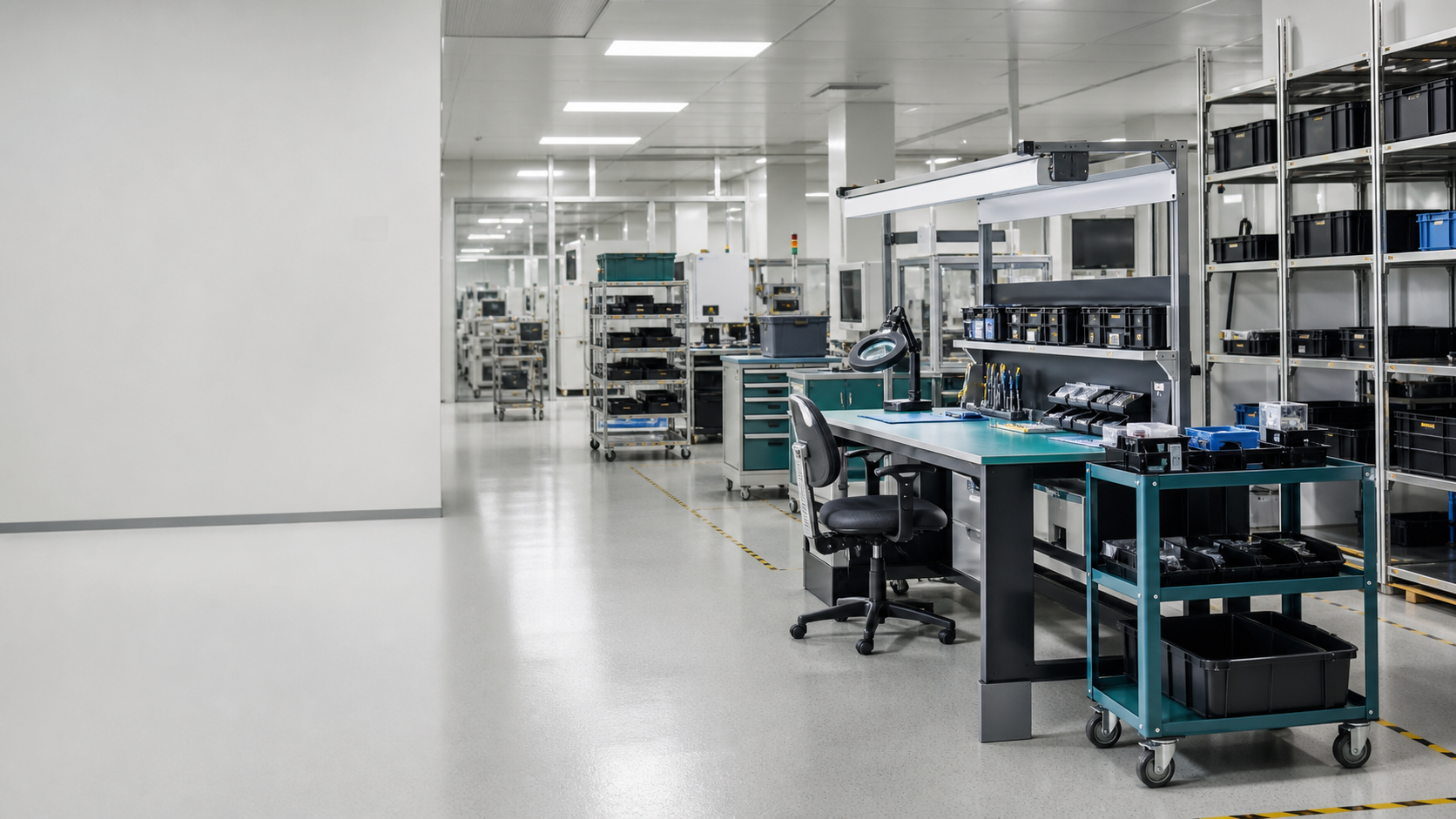
Check the boundary first if the enquiry may belong to another operating environment.
Check boundaryElectronics and Semiconductor Manufacturing Equipment Routes in Singapore
For electronics assembly, semiconductor support, R&D, inspection, repair and technical production areas, start with the bench process, ESD requirement, accessory need, tool storage, lighting, load and documentation before choosing products.
Quick answer
Electronics and semiconductor buyers should route the enquiry by process first: ESD requirement, bench size, accessory layout, small-parts storage, lighting, tool control, chair or trolley need, cleaning exposure and support documentation.
Start with the buyer situation
Pick the closest situation first, then move only as far as the enquiry needs.
Send the minimum site details so the enquiry can be routed before model review.
Send detailsUse quote intake before treating another option as the same fit.
Review quoteCollect photos, measurements, documents and readiness checks before product-path review.
Build evidenceSend these first
Send these first when the enquiry is about a technical bench, ESD-aware route, tool control, storage, marking or support-product application.
Choose or switch route
Use this boundary before treating a technical workcell, ESD route or support-product enquiry as ready for product selection.
What Y K TOH can reply with
After the first electronics message, the reply should separate bench process, ESD-aware routing, storage, marking and support-product needs.
Electronics quote and document intake
Use this when an electronics buyer is comparing ESD benches, technical workstations, accessories, storage, marking or support-product quotes.
Choose review depth
Use this guide to choose the shortest electronics reading path before opening document-sensitive checks.
Choose how far to review
Choose the shortest path after the route map: first-route guidance, proof gathering, or product and reply review.
Use when the buyer is still choosing the industry route, site problem route, first details or first reply.
Use when photos, measurements, documents, readiness or product-option checks decide whether a quote can be compared.
Use when proof is available and the next step is product path, brand role, final checks or reply format.
Photos to send
Use these photo angles before asking for technical workstation, ESD, tool-control, storage, marking or MRO support routes.
Measurements to confirm
Use these measurements before shortlisting technical workstations, ESD routes, support products, access or movement equipment.
Documents to check
Use these documents before comparing technical workstation, ESD route, application-product, access or movement support quotes.
When the route is ready
Use these gates before deciding whether an electronics enquiry is ready for workstation routing, site-fit shortlist or exact product proof.
Product option checks
Use this before treating another bench, ESD workstation, accessory, storage, marker, cleaner or support-product quote as the same fit.
Match buyer wording to the route
Use these common technical-work phrases to separate workstation, ESD, storage and application-product decisions.
Match search wording to routes
Use this router when an electronics or semiconductor buyer searches by workbench, ESD, application product, access or movement wording.
| Buyer search wording | Route to | Evidence to send | Keep held |
|---|---|---|---|
| ESD workbench Singapore | Route to Treston workcell review before choosing bench model, accessories or storage. | Process notes, EPA/ESD requirement, grounding expectation, bench size, load, posture, lighting and accessory list. | ESD compliance, cleanroom, high-purity, electronics-safe and model-fit claims. |
| Technical workstation or assembly bench | Route to workstation layout, posture, tool reach, lighting, storage and document review. | Work sequence, operator count, worktop size, tools, components, shelves, drawers, chairs, trolleys and photos. | Process suitability and productivity wording. |
| Torque seal, marker or contact cleaner | Route to DYKEM or LPS application review by surface, residue and SDS/TDS needs. | Application surface, residue concern, cleaning process, ventilation, product-contact risk and required documents. | Electronics-safe, cleanroom, residue-free and compliance claims. |
| Low-level access or movement support | Route to BRAVI, MasterMover, STOCKY, MYSTAR or INNOPHYS review only when the physical task fits. | Height, load, wheels, route, floor, turning area, task frequency, operator task and product documents. | Access, movement, manual-assist, safety and model-fit wording. |
Which Y K TOH division fits
Use this division route when a technical-work enquiry includes workstation, MRO, storage, access or facility-support items.
| Y K TOH division | Use when | Evidence to send | Keep held |
|---|---|---|---|
| Warehouse Equipment | Support route for technical carts, trolleys, access platforms, movement support and handling review outside the bench decision. | Load, wheels, route, floor, access height, turning area, task frequency and site photos. | Access, movement, manual-assist, safety and model-fit wording. |
| Storage Racking | Support route for component storage, cabinets, shelving, staging, small-parts storage and controlled material flow. | Component size, bin or drawer needs, SKU flow, load, reach zone, workcell photos and current storage issue. | Capacity, ESD, cleanroom, high-purity and process-suitability wording. |
| MRO Chemicals | Primary route for DYKEM, LPS, torque seal, cleaners, marking and application-product review. | Surface, residue concern, ventilation, cleaning process, SDS/TDS need, product-contact risk and exact application. | Electronics-safe, cleanroom, residue-free and compliance claims. |
| Builders Hardware | Support route when facility hardware, fixing, door, wall or maintenance hardware is part of the technical area scope. | Photos, dimensions, fixing surface, site use, current hardware and process adjacency. | Fire, code, safety, access, fixing or process-compliance wording. |
| Household and Commercial Goods | Use only for general commercial supply items that are not controlled by ESD, cleanroom, process or workstation requirements. | Product list, quantity, use area, photos and replacement reference. | ESD, cleanroom, electronics-safe, industrial or safety suitability wording. |
Use this route when
Use this page when the decision is driven by electronics process, ESD-aware work areas, technical bench configuration, tool control or sensitive support products.
Use this page when
- The buyer needs assembly, inspection, repair, R&D, testing, small-parts staging, tool storage or a technical workstation route.
- The process has ESD, grounding, accessory, lighting, chair, trolley, storage or documentation requirements.
- The first decision is the workcell and bench process, not a warehouse movement or cold-room route.
Check another route when
- Use Logistics when the issue is component storage, warehouse packing, distribution, pallet movement or general facility protection.
- Use Cold Chain when temperature-controlled storage, refrigerated transfer or moisture exposure drives suitability.
- Use Food and Beverage only when the site problem is food-area production support, cleaning exposure or contact-risk documentation.
Compare the buying route first
Use this filter when a buyer is comparing ESD benches, generic workbenches, workstation accessories, small-parts storage, marking products or support equipment.
Already comparing a quote?
Use this when comparing ESD benches, technical workstations, accessories, storage, marking or support-product quotes.
WAREHOUSE123 stage route
Use WAREHOUSE123 to separate the electronics workcell layout from movement support and daily technical-work improvements.
Design & Build
ESD-aware workcell layout, bench position, protected walkways, component storage and tool staging.
Use when process flow, ESD control, operator reach or workcell organization is not yet clear.Equip
Trolleys, access equipment, pallet movement and controlled movement routes where the task fits.
Use when parts, tools, equipment or operators need movement support outside the workstation decision.Enhance
Treston accessories, chairs, lighting, drawers, DYKEM marking, LPS support and manual-assist review.
Use when the core bench route is clear but daily work, traceability, maintenance or ergonomics needs improvement.Route the site problem first
The recommendation should follow the operating problem, site data and claim limits before product or model selection.
Proof before product shortlist
Before a bench, trolley, chair, marking or maintenance route is treated as suitable, confirm the process controls and documentation need.
ESD process proof
EPA or ESD requirement, grounding expectation, component sensitivity, site process, accessories and whether standard technical furniture is enough.
Workcell proof
Bench size, load, posture, lighting, power, shelves, tool rails, drawers, chairs, trolleys, parts storage and operator reach.
Documents and claim limits
SDS, TDS, ESD, cleanroom, high-purity, electronics-safe and application claims stay held until product documents and site use are checked.
How much proof is enough
Use this ladder before treating a route as product fit. It keeps route advice, site fit and exact product proof separate.
Recommended category lanes
Use these category lanes to separate workstation, ESD, storage, marking and support choices before a configuration is treated as suitable.
Technical workstation lanes
Use when assembly, inspection, repair, test, R&D or technical production work is driven by the bench process.
- Check bench size, load, worktop route, posture, lighting, shelves, tool rails, drawers and document needs.
ESD and workcell support lanes
Use when the workcell needs ESD control, grounded accessories, component staging, storage or a cleaner bench workflow.
- Check EPA/ESD requirement, component sensitivity, grounding expectation, accessories, storage and work sequence.
Marking and application lanes
Use when the requirement is torque indication, inspection marking, layout marking, paint marking or process support.
- Check surface, residue concern, cleaning process, ventilation, SDS/TDS request and whether sensitive electronics are involved.
Access and movement lanes
Use only when the task is outside the bench decision, such as low-level access, wheeled movement, pallet movement or operator-assist handling.
- Check height, load, wheels, route, floor, turning space, manual task and product documents.
Recommended product and brand routes
Use these routes to decide whether the enquiry starts with workbench process, ESD workcell, small-parts storage, application product, access or movement before exact models are discussed.
Treston technical workstations
Use when the buyer needs benches, modular accessories, storage, chairs, trolleys or structured work areas for assembly, inspection or repair.
- Check ESD requirement before selecting the route.
- Check bench dimensions, load, lighting and accessory needs.
- Hold cleanroom, ESD compliance and process-approval claims until documents are confirmed.
Small-parts storage and layout
Use when the problem is not only the bench, but how tools, components, labels and inspection items are staged.
- Map operator reach and daily task flow.
- Check bins, drawers, shelves and worktop space.
- Avoid overfilling the bench with accessories before process flow is known.
DYKEM and LPS support
Use where marking, torque seal, contact cleaning, lubrication or maintenance support is relevant to the application.
- Check surface, exposure and cleaning process.
- Check data sheets before sensitive electronic use.
- Do not claim electronics-safe or cleanroom fit without product proof.
Access and movement support
Use BRAVI, MasterMover, STOCKY, MYSTAR or INNOPHYS routes only where the physical task clearly fits.
- Check height, route, load, wheels and manual task.
- Keep model-specific claims held until exact use is reviewed.
- Separate workstation selection from movement selection.
Brand roles at a glance
Use this snapshot to separate workstation, ESD workcell, small-parts storage, application product, movement and access questions before any exact model is named.
Treston
Assembly, inspection, repair, R&D, test, technical production and workcell support.
- ESD workbenches, standard technical benches, accessories, chairs, trolleys and storage.
- EPA/ESD need, grounding expectation, bench size, load, posture, accessories and documents.
Small-parts storage route
Component staging, inspection items, tools, consumables and worktop congestion.
- Bins, drawers, cabinets, shelves, labels, tool-control and operator-reach storage.
- Tool list, component sizes, work sequence, reach zones and workcell photos.
DYKEM / LPS
Marking, inspection, cleaning, maintenance or traceability support around technical work.
- Torque seal, industrial marking, contact cleaning, lubricant and application-product review.
- Surface, residue concern, cleaning process, ventilation, SDS/TDS request and contact risk.
BRAVI / MasterMover / STOCKY / MYSTAR
Tasks outside the bench decision where movement, height or access changes the route.
- Low-level access, pallet movement, trolleys, wheeled-load and support movement routes.
- Height, load, wheels, route, floor, turning area, task frequency and documents.
INNOPHYS
Selected repetitive handling or assistive work tasks outside the workstation configuration.
- Manual-assist review route where the exact physical task and documents support review.
- Manual task, body position, load, frequency, route, site photos and product documents.
Where each brand fits
Use this map to keep workstation, ESD, storage, marking, MRO, access and movement routes separate before naming any model.
| Brand route | What it normally supports | Best-fit use case | Proof needed |
|---|---|---|---|
| Treston | ESD workbenches, standard technical benches, accessories, chairs, trolleys and storage. | Assembly, inspection, repair, R&D, test, technical production and workcell support. | EPA/ESD need, grounding expectation, bench size, load, posture, accessories and documents. |
| Small-parts storage route | Bins, drawers, cabinets, shelves, labels, tool-control and operator-reach storage. | Component staging, inspection items, tools, consumables and worktop congestion. | Tool list, component sizes, work sequence, reach zones and workcell photos. |
| DYKEM / LPS | Torque seal, industrial marking, contact cleaning, lubricant and application-product review. | Marking, inspection, cleaning, maintenance or traceability support around technical work. | Surface, residue concern, cleaning process, ventilation, SDS/TDS request and contact risk. |
| BRAVI / MasterMover / STOCKY / MYSTAR | Low-level access, pallet movement, trolleys, wheeled-load and support movement routes. | Tasks outside the bench decision where movement, height or access changes the route. | Height, load, wheels, route, floor, turning area, task frequency and documents. |
| INNOPHYS | Manual-assist review route where the exact physical task and documents support review. | Selected repetitive handling or assistive work tasks outside the workstation configuration. | Manual task, body position, load, frequency, route, site photos and product documents. |
Brand-to-product route matrix
Use this matrix to separate workstation decisions from ESD, marking, MRO, access and movement support before naming any final model.
| Brand route | Product/category route | Use when | Check before recommending |
|---|---|---|---|
| Treston workstation route | ESD workbenches, standard technical benches, accessories, chairs, trolleys and storage | Assembly, inspection, repair, R&D and electronics workcells where the bench process drives the layout. | EPA/ESD requirement, grounding need, bench size, load, posture, lighting, accessory list and documents. |
| Small-parts and tool-control route | Bins, drawers, cabinets, pegboards, shelves, labels and operator-reach storage | Component staging, tool control, inspection items and worktop congestion. | Tool list, component sizes, work sequence, reach zones and photos of the current workcell. |
| DYKEM / LPS application route | Torque seal, industrial marking, contact cleaning and MRO support | Marking, inspection, cleaning or maintenance tasks around sensitive components or equipment. | Surface, residue concern, cleaning process, ventilation, SDS/TDS request and product-contact risk. |
| BRAVI / MasterMover / STOCKY / MYSTAR / INNOPHYS support | Access, movement and manual-assist routes where the physical task fits | Low-level access, wheeled movement, pallet movement, trolleys or manual-assist review outside the bench choice. | Height, load, wheels, route, floor, turning space, operator task and product documents. |
Next product path after proof
Use this path after the electronics route and brand role are clear, before moving into exact workbench, storage, ESD, application, access or movement products.
Buyer comparison
Use this when electronics buyers are comparing workbenches, ESD setups, storage, application products, movement or access options. Compare process, document need and site proof first.
| Buyer choice | What to compare first | What to send Y K TOH |
|---|---|---|
| ESD bench versus standard bench | Actual ESD requirement, grounding route, accessories, process and documents. | Process notes, required documents, bench dimensions and current photos. |
| Bench accessories versus storage | Whether tools and components need to be on the bench, above it, beside it or stored separately. | Tool list, component sizes, reach zones and work sequence. |
| Marking or MRO support | Surface, exposure, cleaning sensitivity and documentation. | Application details, product contact risk and required data sheets. |
What changes the recommendation
The electronics route changes with the process, ESD requirement, workstation layout and product documentation. Send process details before treating any bench, trolley, chair, marking or maintenance product as suitable.
Process and ESD need
Work area, component sensitivity, EPA or ESD requirement, grounding expectation, document need and whether a standard technical bench is enough.
Workcell layout
Bench size, load, posture, lighting, power, shelves, tool rails, drawers, chairs, trolleys, parts storage and operator reach.
Application products
Surface, residue concern, marking task, cleaning exposure, ventilation, torque indication need and any SDS or product-document request.
Selection checklist
Use this checklist before treating any bench, accessory, storage or support product as suitable for electronics work.
Enquiry brief
Use this brief when sending an electronics, semiconductor, assembly, inspection, repair or technical workstation enquiry.
Send these details
- Process description, workcell photos, bench dimensions, operator posture, load, power, lighting and accessory needs.
- Whether the area is EPA/ESD-controlled, the grounding expectation and any ESD document requirement.
- Tools, components, bins, drawers, shelves, chairs, trolleys, labels and operator-reach issues.
- Surface, marking, cleaning, residue, torque seal or maintenance application details where LPS or DYKEM may be reviewed.
Keep these claims held
- ESD-safe, cleanroom, high-purity and electronics-safe claims.
- Final Treston configuration, accessory list and worktop route.
- Any support-product suitability claim without SDS, TDS or product proof.
How to send the details
Use this format when sending an electronics, semiconductor, assembly, repair, inspection or technical workstation enquiry.
Recommendation checks
Use this process after sending process notes, bench photos, ESD requirement, accessory needs and any product-document request.
Decide whether the route is a standard technical bench, ESD-aware workstation, storage/accessory setup or application-product review.
Check bench size, load, reach, lighting, drawers, shelves, tools, components and operator posture before adding support products.
Shortlist Treston, storage, DYKEM, LPS, access or movement routes while holding cleanroom, ESD compliance and electronics-safe claims until documents support them.
Final checks before reply
Use this final check before an electronics or semiconductor route is treated as suitable for a process, workcell or support product.
What the reply should cover
After an electronics buyer sends process details, the reply should separate workcell, ESD, storage and application-product decisions.
Electronics route or another operating environment?
Use the handoff when a technical workcell enquiry becomes controlled by warehouse flow, chilled transfer, production-zone cleaning exposure or food-area documentation.
Stay on Electronics
Use this page for ESD-aware work areas, technical benches, component staging, tool control, inspection, repair, R&D, marking, cleaning and support movement.
Switch to Logistics
Use Logistics when storage, picking, packing, dispatch, loading bay, racking, warehouse protection or general movement flow controls the decision.
Switch to Cold Chain
Use Cold Chain when chilled storage, frozen storage, refrigerated dispatch, cold-room transfer, condensation or temperature exposure controls the route.
Switch to Food and Beverage
Use Food and Beverage when production support, cleaning exposure, contact risk, usage-zone documents or non-food-contact maintenance controls the decision.
Send mixed-route details
If both technical and site-environment issues apply, send process notes, workcell photos, ESD requirement, route, load, floor, exposure and document needs.
Common buyer questions
These answers keep the route logic readable for busy buyers in plain page content.